Astronomers Figure Out a New Way to Search for Planets at Alpha Centauri At a distance of 4.37 light-years from Earth, Alpha Centauri is the nearest star system to our own. For generations, scientists and speculative thinkers have pondered whether it might have a planetary system like our own Sun, and whether or not life may also exist there. Unfortunately, recent efforts to locate extra-solar planets in this star system have failed, with potential detections later shown to be the result of artifacts in the data. In response to these failed efforts, several more ambitious projects are being developed to find exoplanets around Alpha Centauri.Read More →

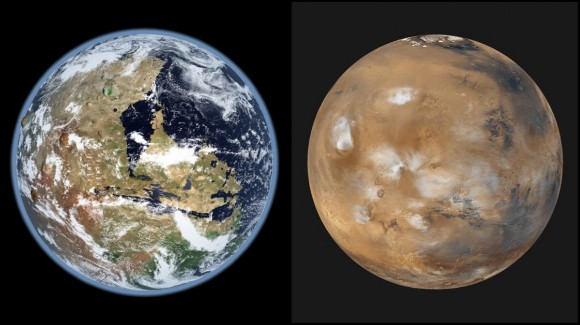
Maybe Mars and Earth Didn’t Form Close to Each Other In recent years, astronomers have been looking to refine our understanding of how the Solar System formed. On the one hand, you have the traditional Nebular Hypothesis which argues that the Sun, the planets, and all other objects in the Solar System formed from nebulous material billions of years ago. However, astronomers traditionally assumed that the planets formed in their current orbits, which has since come to be questioned. This has come to be challenged by theories like the Grand Tack model. This theory states that Jupiter migrated from its original orbit after it formed,Read More →

Red Dwarf Star, Planet Orbiting at Right Angles. Mayhem. When we think of other planetary systems, we tend to think that they will operate by the same basic rules as our own. In the Solar System, the planets orbit close to the equatorial plane of the Sun – meaning around its equator. The Sun’s rotational axis, the direction of its poles based to its rotation, is also the same as most of the planets’ (the exception being Uranus, which rotates on its side). But if the study of extra-solar planets has taught us anything, it is that the Universe is full of possibilities. Consider theRead More →

Weekly Space Hangout – Dec 20, 2017: The Year in Review Hosts: Fraser Cain (universetoday.com / @fcain) Dr. Paul M. Sutter (pmsutter.com / @PaulMattSutter) Dr. Kimberly Cartier (KimberlyCartier.org / @AstroKimCartier ) Dr. Morgan Rehnberg (MorganRehnberg.com / @MorganRehnberg & ChartYourWorld.org) Announcements: If you would like to join the Weekly Space Hangout Crew, visit their site here and sign up. They’re a great team who can help you join our online discussions! We record the Weekly Space Hangout every Wednesday at 5:00 pm Pacific / 8:00 pm Eastern. You can watch us live on Universe Today, or the Weekly Space Hangout YouTube page – Please subscribe! TheRead More →

Updates on ‘Oumuamau. Maybe it’s a Comet, Actually. Oh, and no Word From Aliens. On October 19th, 2017, the Panoramic Survey Telescope and Rapid Response System-1 (Pan-STARRS-1) in Hawaii announced the first-ever detection of an interstellar object, named 1I/2017 U1 (aka. ‘Oumuamua). After originally hypothesizing that it was a comet, observations performed by the European Southern Observatory (ESO) and other astronomers indicated that it was likely a strange-looking asteroid measuring about 400 meters (1312 ft) long. Since that time, multiple surveys have been conducted to determine the true nature of this asteroid, which have included studies of its composition to Breakthrough Listen‘s proposal to listenRead More →

Kilonova Neutron Star Collision Probably Left Behind a Black Hole In February of 2016, scientists from the Laser Interferometer Gravitational-Wave Observatory (LIGO) announced the first-ever detection of gravitational waves. A little over a century after they were first predicted by Einstein’s Theory of General Relativity, we finally had proof that this phenomenon existed. In August of 2017, another major breakthrough occurred when LIGO detected waves that were believed to be caused by a neutron star merger. Shortly thereafter, scientists at LIGO, Advanced Virgo, and the Fermi Gamma-ray Space Telescope were able to determine where in the sky the neutron star merger occurred. While many studiesRead More →

Astronomers Find Another Solar System with 8 Planets. Uh, Pluto, About that Deplaneting… With every passing year, more and more extra-solar planets are discovered. To make matters more interesting, improvements in methodology and technology are allowing for the discovery of more planets within individual systems. Consider the recent announcement of a seven-planet system around the red dwarf star known as TRAPPIST-1. At the time, this discovery established the record for most exoplanets orbiting a single star. Well move over TRAPPIST-1! Thanks to the Kepler Space Telescope and machine learning, a team from Google AI and the Harvard-Smithsonian Center of Astrophysics (CfA) recently discovered an eighthRead More →

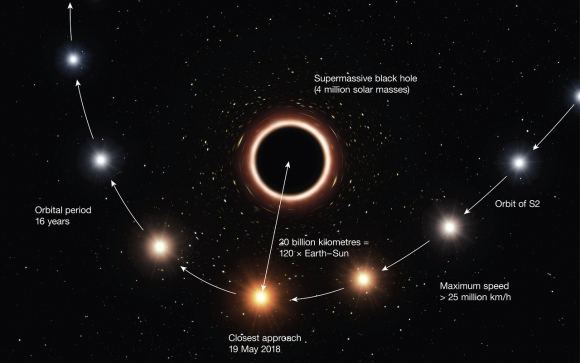
Carnival of Space #540 Welcome, come in to the 540th Carnival of Space! The Carnival is a community of space science and astronomy writers and bloggers, who submit their best work each week for your benefit. So now, on to this week’s stories! First up, Chandra Reveals the Elementary Nature of Cassiopeia A over at the Chandra X Ray Observatory Blog. Then, we visit The Venus Transit where we read about the Supermoon rises sunsets and halos. Cold weather and high clouds doing great for the urban stargazer. Next, we return here to Universe Today. Matt Williams shares that a Monster Black Hole Seen ShortlyRead More →

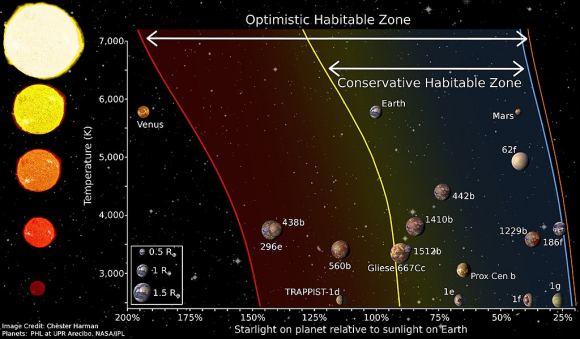
How Long Can a Rocky World Withstand the Blasts From a Red Dwarf Star? Red dwarf stars have become a major focal point for exoplanet studies lately, and for good reason. For starters, M-type (red dwarf) stars are the most common type in our Universe, accounting for 75% of stars in the Milky Way alone. In addition, in the past decade, numerous terrestrial (i.e rocky) exoplanets have been discovered orbiting red dwarf stars, and within their circumstellar habitable zones (“Goldilocks Zones”) to boot. This has naturally prompted several studies to determine whether or not rocky planets can retain their atmospheres. The latest study comes fromRead More →

Gaia Looks Beyond our Galaxy to Other Islands of Stars The European Space Agency’s (ESA) Gaia mission is an ambitious project. Having launched in December of 2013, the purpose of this space observatory has been to measure the position and distances of 1 billion objects – including stars, extra-solar planets, comets, asteroids and even quasars. From this, astronomers hope to create the most detailed 3D space catalog of the cosmos ever made. Back in 2016, the first batch of Gaia data (based on its first 14 months in space) was released. Since then, scientists have been pouring over the raw data to obtain clearer imagesRead More →

Are Little Blue Dots in the Hubble Frontier Fields Precursors to Globular Clusters? In 2012, the Hubble Space Telescope Frontier Fields program (aka. Hubble Deep Fields Initiative 2012) officially kicked off. The purpose of this project was to study the faintest and most distant galaxies in the Universe using the gravitational lensing technique, thus advancing our knowledge of early galaxy formation. By 2017, the Frontier Field program wrapped up, and the hard work of analyzing all the data it collected began. One of the more interesting finds within the Frontier Fields data has been the discovery of low mass galaxies with high star formation rates.Read More →

NASA’s Opportunity Rover Withstands Another Harsh Winter on Mars When the Opportunity rover landed on Mars on January 25th, 2004, its mission was only meant to last for about 90 Earth days. But the little rover that could has exceeded all expectations by remaining in operation (as of the writing of this article) for a total of 13 years and 231 days and traveled a total of about 50 km (28 mi). Basically, Opportunity has continued to remain mobile and gather scientific data 50 times longer than its designated lifespan. And according to a recent announcement from NASA’s Mars Exploration Program (MEP), the rover managedRead More →

Meteors Explode from the Inside When They Reach the Atmosphere Earth is no stranger to meteors. In fact, meteor showers are a regular occurrence, where small objects (meteoroids) enter the Earth’s atmosphere and radiate in the night sky. Since most of these objects are smaller than a grain of sand, they never reach the surface and simply burn up in the atmosphere. But very so often, a meteor of sufficient size will make it through and explode above the surface, where it can cause considerable damage. A good example of this is the Chelyabinsk meteoroid, which exploded in the skies over Russia in February ofRead More →

86 Stars Just got Official Names from the IAU When we think of the most commonly-known stars in the night sky, what springs to mind? Chances are, it would be stars like Sirius, Vega, Deneb, Rigel, Betelgeuse, Polaris, and Arcturus – all of which derive their names from Arabic, Greek or Latin origins. Much like the constellations, these names have been passed down from one astronomical tradition to another and were eventually adopted by the International Astronomical Union (IAU). But what about the astronomical traditions of Earth’s many, many other cultures? Don’t the names they applied to heavens also deserve mention? According to the IAU,Read More →

What is the Perfect Gift for Every Space Enthusiast? The Year in Space Calendar 2018! What is the most wonderful time of the year? In my opinion, it is when the new Year In Space Calendars come out! This is our most-recommended holiday gift every year and whether it’s the gigantic wall calendar or the spiral-bound desk calendar the 2018 versions don’t disappoint. They are full of wonderful color images, daily space facts, and historical references. These calendars even show you where you can look in the sky for all the best astronomical sights. These calendars are the perfect gift every space enthusiast will enjoyRead More →

Carnival of Space #539 This week’s Carnival of Space is hosted by Brian Wang at his Next Big Future blog. Click here to read Carnival of Space #539 And if you’re interested in looking back, here’s an archive to all the past Carnivals of Space. If you’ve got a space-related blog, you should really join the carnival. Just email an entry to carnivalofspace@gmail.com, and the next host will link to it. It will help get awareness out there about your writing, help you meet others in the space community – and community is what blogging is all about. And if you really want to help out, sign upRead More →

Weekly Space Hangout – Dec 13, 2017: Emilio Enriquez and SETI’s Breakthrough Listen Initiative Hosts: Fraser Cain (universetoday.com / @fcain) Dr. Paul M. Sutter (pmsutter.com / @PaulMattSutter) Dr. Kimberly Cartier (KimberlyCartier.org / @AstroKimCartier ) Dr. Morgan Rehnberg (MorganRehnberg.com / @MorganRehnberg ChartYourWorld.org) Special Guests: Dr. Emilio Enriquez is a Post Doc at the Berkeley SETI Research Center and a member of the Breakthrough Listen Initiative (http://seti.berkeley.edu/listen/). Emilio is the lead author of two recent SETI Research Center publications about Ross 128 b, the nearby exoplanet that researchers feel may have conditions that are conducive to life. His expertise is in modelling of physical processes in galaxies,Read More →

New Map Shows the Motion of all the Galaxies in Our Supercluster For almost a century, astronomers have understood that the Universe is in a state of expansion. This is a consequence of General Relativity, and the rate at which it is expanding is known as the Hubble Constant – named after the man who first noticed the phenomena. However, astronomers have also learned that withing the large-scale structures of the Universe, galaxies and clusters have also been moving closer and relative to one other. For decades, astronomers have sought to track how these movements have taken place over the course of cosmic history. AndRead More →

Breakthrough Listen is Going to Scan ‘Oumuamua, You Know, Just to be Sure it’s Just an Asteroid and Not a Spaceship. On October 19th, 2017, the Panoramic Survey Telescope and Rapid Response System-1 (Pan-STARRS-1) in Hawaii announced the first-ever detection of an interstellar asteroid, named 1I/2017 U1 (aka. ‘Oumuamua). Based on subsequent measurements of its shape (highly elongated and thin), there was some speculation that it might actually be an interstellar spacecraft (the name “Rama” ring a bell?). For this reason, there are those who would like to study this object before it heads back out into interstellar space. While groups like Project Lyra proposeRead More →

Messier 63 – the Sunflower Galaxy Welcome back to Messier Monday! Today, we continue in our tribute to our dear friend, Tammy Plotner, by looking at the “Sunflower Galaxy”, otherwise known as Messier 63. In the 18th century, while searching the night sky for comets, French astronomer Charles Messier kept noting the presence of fixed, diffuse objects he initially mistook for comets. In time, he would come to compile a list of approximately 100 of these objects, hoping to prevent other astronomers from making the same mistake. This list – known as the Messier Catalog – would go on to become one of the mostRead More →