European astronomers have conducted a study of Przybylski’s star and found that it takes almost 200 years to fully rotate on its own axis. The finding, which could have implications for the understanding of chemically peculiar stars, is reported April 19 in a paper published on the arXiv pre-print repository. Powered by WPeMaticoRead More →
To accelerate the pace of discovery and exploration of the cosmos, a multi-institution team of astronomers and engineers has developed a new and improved version of an unconventional radio-astronomy imaging system known as a phased array feed (PAF). This remarkable instrument can survey vast swaths of the sky and generate multiple views of astronomical objects with unparalleled efficiency. Powered by WPeMaticoRead More →
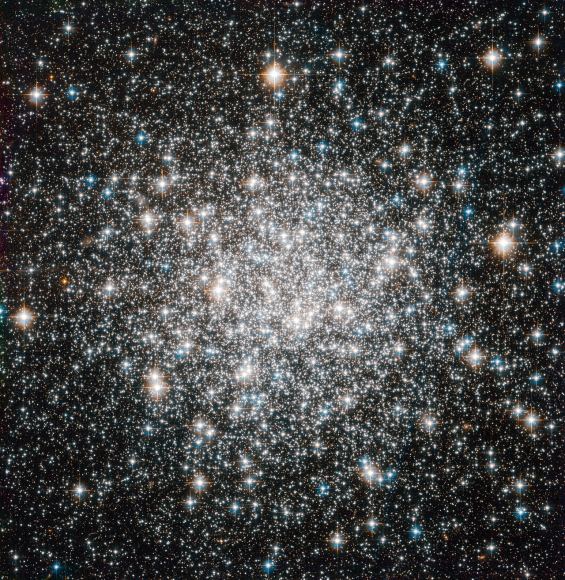
Messier 68 – the NGC 4590 Globular Cluster Welcome back to Messier Monday! Today, we continue in our tribute to our dear friend, Tammy Plotner, by looking at the globular cluster known as Messier 68. In the 18th century, while searching the night sky for comets, French astronomer Charles Messier kept noting the presence of fixed, diffuse objects he initially mistook for comets. In time, he would come to compile a list of approximately 100 of these objects, hoping to prevent other astronomers from making the same mistake. This list – known as the Messier Catalog – would go on to become one of theRead More →

Carnival of Space #559 This week’s Carnival of Space is hosted by Brian Wang at his Next Big Future blog. Click here to read Carnival of Space #559 And if you’re interested in looking back, here’s an archive to all the past Carnivals of Space. If you’ve got a space-related blog, you should really join the carnival. Just email an entry to susie@wshcrew.space, and the next host will link to it. It will help get awareness out there about your writing, help you meet others in the space community – and community is what blogging is all about. And if you really want to help out, sign upRead More →

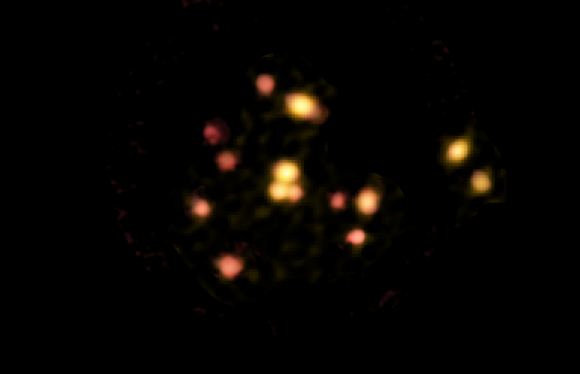
Astronomers See a Pileup of 14 Separate Galaxies in the Early Universe Looking deep into the observable Universe – and hence, back to the earliest periods of time – is an immensely fascinating thing. In so doing, astronomers are able to see the earliest galaxies in the Universe and learn more about how they evolved over time. From this, they are not only able to see how large-scale structures (like galaxies and galaxy clusters) formed, but also the role played by dark matter. Most recently, an international team of scientists used the Atacama Large Millimeter-submillimeter Array (ALMA) to observe the Universe when it was justRead More →

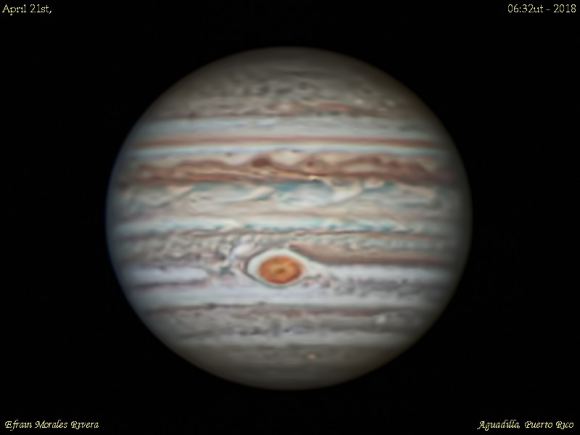
By Jove: Jupiter at Opposition for 2018 A recent capture of Jupiter from April 21st. Image credit and copyright: Efrain Morales Rivera. It’s a question I’ve fielded lots this weekend leading up to last night’s April Pink Full Moon, and one I expect we’ll get again tonight: “What’s that bright star near the Moon?” That bright “star” is actually a planet, the king of them all as far as our Solar System is concerned: Jupiter. May also ushers in Jupiter observing season, as the planet reaches opposition on May 9th, rising in the east opposite to the setting Sun to the west. Jupiter now joinsRead More →

China’s 500-meter Aperture Spherical radio Telescope (FAST) discovered a radio millisecond pulsar (MSP) coincident with the unassociated gamma-ray source 3FGL J0318.1+0252 in the Fermi Large Area Telescope (LAT) point-source list. This is another milestone of FAST. Powered by WPeMaticoRead More →

An international team led by researchers at CNRS, Université Grenoble Alpes and the French Alternative Energies and Atomic Energy Commission (CEA) has challenged currently held ideas about star formation. Published in Nature Astronomy, the findings could challenge the widespread assumption that the mass distribution of a population of star-forming cores is identical to that of the stars they spawn. Powered by WPeMaticoRead More →

This pretty, cloud-like object may not look much like a galaxy—it lacks the well-defined arms of a spiral galaxy, or the reddish bulge of an elliptical—but it is in fact something known as a lenticular galaxy. Lenticular galaxies sit somewhere between the spiral and elliptical types; they are disk-shaped, like spirals, but they no longer form large numbers of new stars and thus contain only aging populations of stars, like ellipticals. Powered by WPeMaticoRead More →

Jeff Bezos Says The New Shepard Will Soar Next on Sunday. Here’s How to Watch It Live. One of the greatest challenges of modern spaceflight is finding a way to make launching rockets into space commercially viable. Reduced costs will not only mean more launches, but the ability to conduct more ambitious programs in Low Earth Orbit (LEO) and beyond. To this end, many private aerospace companies are investing in reusability, where the first-stages of a rocket and even entire vehicles are retrieved after launch and reused. In recent years, Elon Musk has become famous for his development of reusable first-stage boosters and fairings. ButRead More →

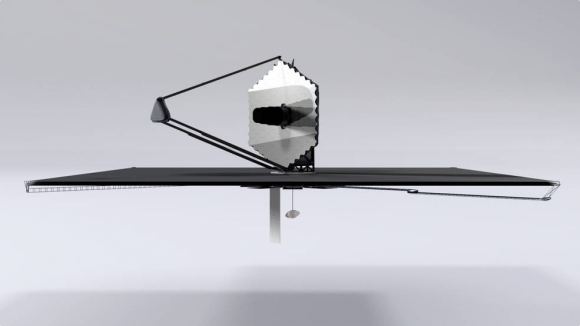
Dream About the Future of Big Telescopes; Monster Space Telescopes That Could Fly by the 2030s With the recent launch of the Transiting Exoplanet Survey Satellite (TESS) – which took place on Wednesday, April 18th, 2018 – a lot of attention has been focused on the next-generation space telescopes that will be taking to space in the coming years. These include not only the James Webb Space Telescope, which is currently scheduled for launch in 2020, but some other advanced spacecraft that will be deployed by the 2030s. Such was the subject of the recent 2020 Decadal Survey for Astrophysics, which included four flagship mission conceptsRead More →

The nuclei of most galaxies host supermassive black holes with millions or even billions of solar-masses of material. Material in the vicinity of such black holes can accrete onto a torus of dust and gas around the black hole, and when that happens the nuclei radiate powerfully across the full spectrum. These active galactic nuclei (AGN) are among the most dramatic and interesting phenomena in extragalactic astronomy, and puzzling as well. Exactly what turns the accretion on or off is not understood, nor is how the associated processes produce the emission, generate jets of particles, or influence star formation in the galaxy. Powered by WPeMaticoRead More →

A New Supernova Over Munich On 26 April 2018, the ESO Supernova Planetarium & Visitor Centre was officially inaugurated, and its doors will be open to the public from tomorrow 28 April 2018. The centre, located at ESO Headquarters in Garching, Germany provides visitors with an immersive experience of astronomy in general, along with ESO-specific scientific results, projects, and technological breakthroughs. All activities in the ESO Supernova will be free of charge during 2018, and shows and other events can be booked online. ESO News Feed Go to Source Powered by WPeMaticoRead More →

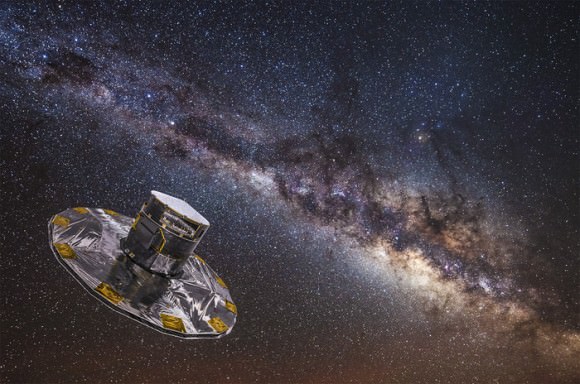
Thanks to a Massive Release from Gaia, we now Know Where 1.7 BILLION Stars are in the Milky Way On December 19th, 2013, the European Space Agency’s (ESA) Gaia spacecraft took to space with one of the most ambitious missions ever. Over the course of its planned 5-year mission (which was recently extended), this space observatory would map over a billion stars, planets, comets, asteroids and quasars in order to create the largest and most precise 3D catalog of the Milky Way ever created. The first release of Gaia data, which took place in September 2016, contained the distances and motions of over two millionRead More →

Seventeen years ago, astronomers witnessed a supernova go off 40 million light-years away in the galaxy called NGC 7424, located in the southern constellation Grus, the Crane. Now, in the fading afterglow of that explosion, NASA’s Hubble has captured the first image of a surviving companion to a supernova. This picture is the most compelling evidence that some supernovas originate in double-star systems. Powered by WPeMaticoRead More →

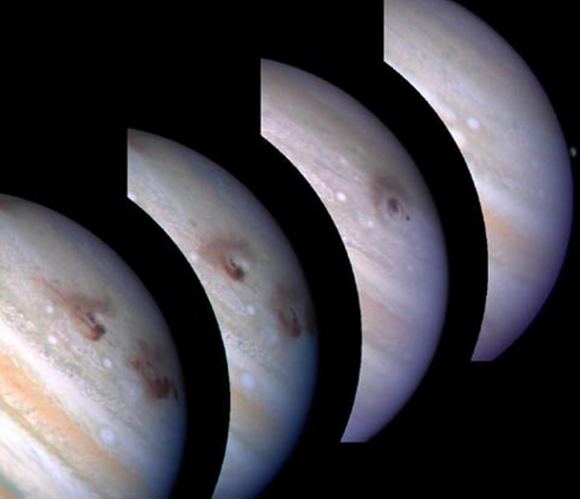
Asteroids Smack Jupiter More Often Than Astronomers Thought Pow: The July 1994 impact of Comet Shoemaker-Levy 9 on Jupiter, captured by the Hubble Space Telescope. Credit: R. Evans/J. Trauger/H. Hammel/HST Comet Science Team/NASA. Are you keeping a eye on Jupiter? The King of the Planets, Jove presents a swirling upper atmosphere full of action, a worthy object of telescopic study as it heads towards another fine opposition on May 9th, 2018. Now, an interesting international study out of the School of Engineering in Bilbao, Spain, the Astronomical Society of France, the Meath Astronomical Group in Dublin Ireland, the Astronomical Society of Australia, and the EsteveRead More →

Veils of dust wrapped around distant stars could make it difficult for scientists to find potentially habitable planets in those star systems. The Hunt for Observable Signatures of Terrestrial Systems, or HOSTS, survey was tasked with learning more about the effect of dust on the search for new worlds. The goal is to help guide the design of future planet-hunting missions. In a new paper published in the Astrophysical Journal, HOSTS scientists report on the survey’s initial findings. Powered by WPeMaticoRead More →