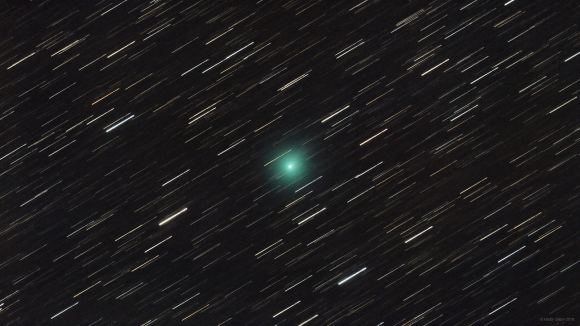
Catch Comet 41P Tuttle-Giacobini-Kresák At Its Best Comet 41P Tuttle-Giacobini-Kresák glows green (left) and shows its true coma and just the hint of a stubby tail in the negative (red) image (right) from March 19th. Image credit and copyright: Hisayoshi Kato Miss out on comet 45P Honda-Mrkos-Pajdušáková? Is Comet 2P Encke too low in the dawn sky for your current latitude? Well, the Universe is providing us northerners with another shot at a fine binocular comet, as 41P Tuttle-Giacobini-Kresák glides through Ursa Major this week. As seen from 30 degrees north, Comet 41P Tuttle-Giacobini-Kresák (sometimes called “Comet 41P” or “Comet TGK”) starts the last weekRead More →

Delta IV Delivers Daunting Display Powering International Military WGS-9 SatCom to Orbit ULA Delta IV rocket streaks to orbit carrying the Wideband Global SATCOM (WGS-9) tactical communications satellite for the U.S. Air Force and international partners from Cape Canaveral Air Force Station, Fl, at 8:18 p.m. EDT on Mar. 18, 2017, in this long exposure photo taken on base. Credit: Ken Kremer/kenkremer.com CAPE CANAVERAL AIR FORCE STATION, FL – On the 70th anniversary year commemorating the United States Air Force, a ULA Delta IV rocket put on a daunting display of nighttime rocket fire power shortly after sunset Saturday, March 19 – powering a highRead More →

A Family Of Stars Torn Apart It sometimes doesn’t take much to tear a family apart. A Christmas dinner gone wrong can do that. But for a family of stars to be torn apart, something really huge has to happen. The dramatic break-up of a family of stars played itself out in the Orion Nebula, about 600 years ago. The Orion Nebula is one of the most studied objects in our galaxy. It’s an active star forming region, where much of the star birth is concealed behind clouds of dust. Advances in infrared and radio astronomy have allowed us to peer into the Nebula, andRead More →

Get Ready For The >100 Planet Solar System Pluto’s status as a non-planet may be coming to an end. Professor Mike Brown of Caltech ended Pluto’s planetary status in 2006. But now, Kirby Runyon, a doctoral student at Johns Hopkins University, thinks it’s time to cancel that demotion and restore it as our Solar System’s ninth planet. Pluto’s rebirth as a planet is not just all about Pluto, though. A newer, more accurate definition of what is and what is not a planet is needed. And if Runyon and the other people on the team he leads are successful, our Solar System would have moreRead More →

Sunset Delta Set to Dazzle Cape with Mighty Air Force SatCom Launch March 18 – Watch Live ULA Delta IV rocket poised for sunset blastoff with the Wideband Global SATCOM (WGS-9) mission for the U.S. Air Force from Cape Canaveral Air Force Station, Fl, on Mar. 18, 2017. Credit: Ken Kremer/kenkremer.com CAPE CANAVERAL AIR FORCE STATION, FL – As sunset dawns on the venerable Delta rocket program, the sole Delta slated to launch from the Cape this year is set to dazzle at sunset tonight, Saturday, March 18. And the launch site is drenched with brilliant blue skies this afternoon as I watched the DeltaRead More →

Stunning Imagery Shows 1st Nighttime Falcon 9 Launch off Pad 39A; EchoStar XXIII Photo/Video Gallery SpaceX Falcon 9 rocket streaks to orbit with EchoStar XXIII TV satellite in this long exposure photo taken in front of NASA’s countdown clock under moonlit skies at the Kennedy Space Center in Florida on March 16 at 2:00 a.m. EDT. Credit: Ken Kremer/Kenkremer.com KENNEDY SPACE CENTER, FL – The opening volley of March Launch Madness started brilliantly as showcased by stunning imagery of the inaugural nighttime launch of a SpaceX Falcon 9 off historic pad 39A under moonlit skies along the Florida Space Coast on Thursday, March 15. TheRead More →

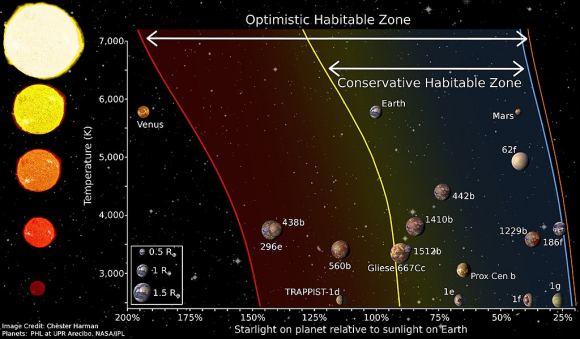
TRAPPIST 1: An Evening With Fraser Cain In case you haven’t heard, some new potentially habitable planets were discovered, and they’re named after beer. To celebrate two of our favorite things finally coming together, Forbidden Brewing Co. welcomes local space expert Fraser Cain for an evening of space talk, beer, and pizza. The newly discovered planets are called the TRAPPIST-1 planets, and they’re named after a type of beer brewed by Belgian Trappist Monks. The knowledgeable and entertaining Fraser Cain will host the evening, and will answer your questions about these fascinating planets and their star. Whether you’re just curious, or you’re a bona fideRead More →

NASA Twins Study Researchers Take Genetic Data To Next Level People who plan and conduct space missions never tire of telling us how hard it is to do things in space. Our next big goal is getting humans to Mars, and establishing a colony there. There are a multitude of technical and engineering hurdles to be overcome, but we think we can do it. But the other side of the coin is the physiological hurdles to be overcome. Those may prove to be much more challenging to deal with. NASA’s twins study is poised to add an enormous amount of data to our growing bodyRead More →

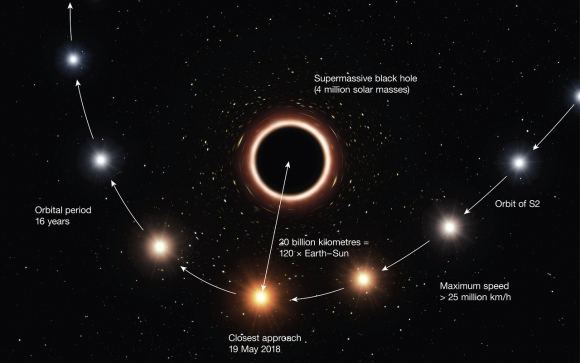
Weekly Space Hangout – Mar 17, 2017: Stuart McNeill of the Intrepid Sea, Air & Space Museum Host: Fraser Cain (@fcain) Special Guest: Stuart McNeill is the the Community Engagement specialist in charge of Family Programs and Demonstrations at the Intrepid Sea, Air & Space Museum. Check out their membership site here. Guests: Kimberly Cartier ( KimberlyCartier.org / @AstroKimCartier ) Paul M. Sutter (pmsutter.com / @PaulMattSutter) Their stories this week: The original weird star: Przybylski’s Star may contain short-lived isotopes Enceladus’ sub-surface ocean under thin(ner) ice Star orbiting black hole at 1% c We use a tool called Trello to submit and vote on storiesRead More →

Last Look At Mimas For A Long Time Since the Cassini mission arrived in the Saturn system in 2004, it has provided some stunning images of the gas giant and its many moons. And in the course of capturing new views of Titan’s dense atmosphere, Iapetus’ curious “yin-yang” coloration, and the water plumes and “tiger stripes” of Enceladus, it snapped the most richly-detailed images of Mimas ever seen. But like all good things, Cassini’s days of capturing close-up images of Mimas are coming to an end. As of January 30th, 2017, the probe made its final close approach to the moon, and took the lastRead More →

Zero2Infinity Successfully Test Launches Its Bloostar Prototype Founded in 2009, the private aerospace company Zero2Infinity – which is headquartered in Barcelona, Spain – was created with the vision of delivering orbital payloads and providing space tourism on a budget. But unlike your conventional aerospace companies – i.e. SpaceX, Blue Origin, Orbital ATK, etc – their plan is to do it all using high-altitude stratospheric balloons. On March 1st, the Zero2Infinity team passed a major milestone, deploying a prototype “rockoon” craft from the National Institute of Aerospace Technology‘s (INTA) facility in El Arenosillo, Spain. Known as Bloostar, this two-stage craft (which consists of a balloon andRead More →

Flawless SpaceX Falcon 9 Takes Rousing Night Flight Delivery of EchoStar TV Sat to Orbit The SpaceX Falcon 9 launches the EchoStar 23 telecomsat from historic Launch Complex 39A with countdown clock in foreground at NASA’s Kennedy Space Center as display shows liftoff progress to geosynchronous orbit after post midnight blastoff on March 16 at 2:oo a.m. EDT. Credit: Ken Kremer/Kenkremer.com KENNEDY SPACE CENTER, FL – Under stellar Florida skies, a private SpaceX Falcon 9 took flight overnight and flawlessly delivered the commercial EchoStar 23 television satellite to geosynchronous orbit after high winds delayed the rockets roar to orbit by two days from Tuesday. BreakingRead More →

Russia Recruiting For Its Moon Bound Cosmonauts   Roscosmos has certainly come a long way in the past few decades. After facing an uncertain future in the 1990s, the federal space agency has rebounded to become a major player in space and a crucial partner in the International Space Station. And in the coming years, Roscosmos hopes to expand its reach further, with missions planned to the Moon and even Mars. Towards this end, on Tuesday, March 14th, the agency announced that it is conducting a recruitment drive for new cosmonauts. All are welcome, the agency stressed, to apply to become the next-generation of spaceRead More →

How Far is Venus From the Sun? Earth and Venus are often called “sister planets” because they share some key characteristics. Like Earth, Venus is a terrestrial planet (i.e. composed of silicate minerals and metals) and orbits within our Sun’s habitable zone. But of course, they are also some major differences between them, like the fact that Venus’ is atmosphere is extremely dense and the hottest in the Solar System. This is particularly interesting when you consider that Venus is not the closest planet to our Sun (that would be Mercury). In fact, its distance from the Sun is just over 70% the distance betweenRead More →

High Winds Scrub Legless Falcon 9 Liftoff Reset to March 16 – Live Webcast The countdown clock at NASA’s Kennedy Space Center shows the progress of the SpaceX Falcon launch attempt with the EchoStar 23 telecomsat from historic Launch Complex 39A after midnight March 14. Liftoff has been rescheduled for March 16 at 1:35 a.m. EDT. Credit: Ken Kremer/Kenkremer.com KENNEDY SPACE CENTER, FL – High winds halted SpaceX’s early morning attempt to launch a legless Falcon 9 rocket and the EchoStar XXIII commercial communications satellite soon after midnight Tuesday, Mar. 14, from the Florida Space Coast amidst on and off rain showers and heavy cloudRead More →

NASA Brings Trappist-1 Into Focus… Kinda Sorta On February 22nd, 2017, NASA announced the discovery of a seven-planet system around the red dwarf star known as TRAPPIST-1. Since that time, a number of interesting revelations have been made. For starters, the Search for Extra-Terrestrial Intelligence (SETI) recently announced that it was already monitoring this system for signs of advanced life (sadly, the results were not encouraging). In their latest news release about this nearby star system, NASA announced the release of the first images taken of this system by the Kepler mission. As humanity’s premier planet-hunting mission, Kepler has been observing this system since DecemberRead More →

Warm Poles Suggest Enceladus’ Liquid Water Near Surface One of the biggest surprises from the Cassini mission to Saturn has been the discovery of active geysers at the south pole of the moon Enceladus. At only about 500 km (310 miles) in diameter, the bright and ice-covered moon should be too small and too far from the Sun to be active. Instead, this little moon is one of the most geothermally active places in the Solar System. Now, a new study from Cassini data shows that the south polar region of Enceladus is even warmer than expected just a few feet below its icy surface.Read More →

Canada To Get Its Own Spaceport Canada is getting its own rocket-launching facility. Maritime Launch Services (MLS) has confirmed its plans to build and operate a commercial launch facility in Nova Scotia, on Canada’s east coast. The new spaceport should begin construction in 1 year, and should be in operation by 2022. The facility will be built near Canso, in the province of Nova Scotia. Maritime Launch Services hopes to launch 8 rockets per year to place satellites in orbit. The Ukrainian Cyclone 4M medium-class rockets that will lift-off from Canso will have a payload of up to 3,350 kg. The red marker in theRead More →

Trump’s NASA Authorization Act In All Its Glory It’s no secret that NASA has had its share of worries with the Trump administration. In addition to being forced to wait several months to get a sense of the administration’s priorities, the space agency has also had to contend with proposed cuts to its Earth Observation and climate monitoring programs. But one thing which does not appear to be threatened is NASA’s “Journey to Mars“. In accordance with the National Aeronautics and Space Administration Transition Authorization Act of 2017, the Trump administration has finally committed to funding NASA’s plans for deep space human exploration in theRead More →

What’s on the Surface of Venus? We’re always talking about Mars here on the Guide to Space. And with good reason. Mars is awesome, and there’s a fleet of spacecraft orbiting, probing and crawling around the surface of Mars. The Red Planet is the focus of so much of our attention because it’s reasonably close and offers humanity a viable place for a second home. Well, not exactly viable, but with the right technology and techniques, we might be able to make a sustainable civilization there. We have the surface of Mars mapped in great detail, and we know what it looks like from theRead More →