It seems like even black holes can’t resist the temptation to insert themselves unannounced into photographs. A cosmic photobomb found as a background object in images of the nearby Andromeda galaxy has revealed what could be the most tightly coupled pair of supermassive black holes ever seen. Powered by WPeMaticoRead More →

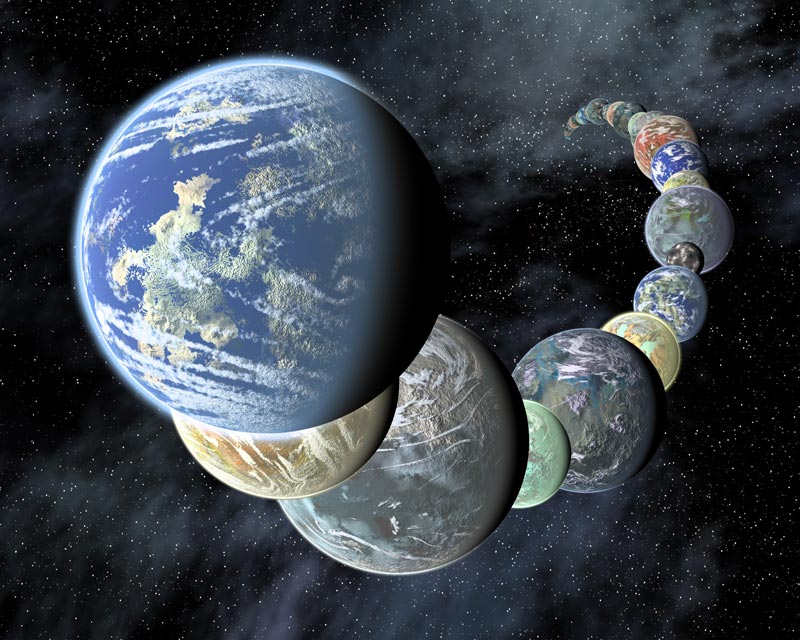
The Genesis Project: Using Robotic Gene Factories to Seed the Galaxy with Life In the past decade, the rate at which extra-solar planets have been discovered and characterized has increased prodigiously. Because of this, the question of when we might explore these distant planets directly has repeatedly come up. In addition, the age-old question of what we might find once we get there – i.e. is humanity alone in the Universe or not? – has also come up with renewed vigor. These questions have led to a number of interesting and ambitious proposals. These include Project Blue, a space telescope which would directly observe anyRead More →

A NASA-led team has found evidence that the oversized exoplanet WASP-18b is wrapped in a smothering stratosphere loaded with carbon monoxide and devoid of water. The findings come from a new analysis of observations made by the Hubble and Spitzer space telescopes. Powered by WPeMaticoRead More →

Weekly Space Hangout – Nov. 29, 2017: Dean Regas’ “100 Things to See in the Night Sky” Hosts: Fraser Cain (universetoday.com / @fcain) Dr. Paul M. Sutter (pmsutter.com / @PaulMattSutter) Dr. Kimberly Cartier (KimberlyCartier.org / @AstroKimCartier ) Dr. Morgan Rehnberg (MorganRehnberg.com / @MorganRehnberg ChartYourWorld.org) Special Guests: Dean Regas is the Astronomer for the Cincinnati Observatory and co-host of the PBS series Star Gazers with James Albury. Viewers may remember that last November, Dean was a guest on the WSH during which he told us about his first book, “Facts From Space!” We are once again pleased to welcome Dean back to the WSH, this timeRead More →

New simulations show that the search for life on other planets may well be more difficult than previously assumed, in research published today in the journal Monthly Notices of the Royal Astronomical Society. The study indicates that unusual air flow patterns could hide atmospheric components from telescopic observations, with direct consequences for formulating the optimal strategy for searching for (oxygen-producing) life such as bacteria or plants on exoplanets. Powered by WPeMaticoRead More →

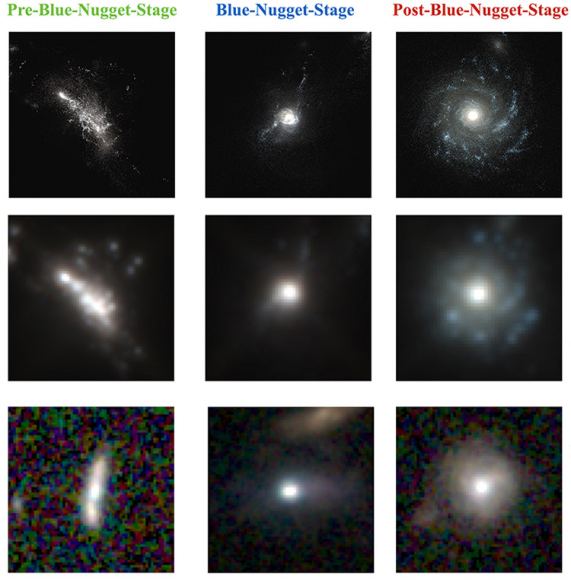
The current cosmological model to explain the universe, the “Big Bang” model, aims to describe all observable phenomena, including the evolution of galaxies from earliest times to the present day. One of the major problems in the Standard Model is that it predicts a star formation rate that is far too high. All the star-forming material in galaxies should have coalesced into stars when the universe was only a fraction of its present age of 13.8 billion years. However, over half the galaxies we see, mainly spirals, are actively forming stars right now. This discrepancy between theoretical prediction and observation has forced researchers to lookRead More →

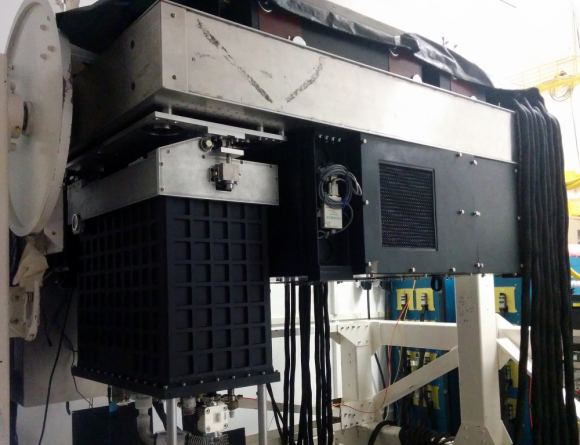
MUSE Probes Uncharted Depths of Hubble Ultra Deep Field Astronomers using the MUSE instrument on ESO’s Very Large Telescope in Chile have conducted the deepest spectroscopic survey ever. They focused on the Hubble Ultra Deep Field, measuring distances and properties of 1600 very faint galaxies including 72 galaxies that have never been detected before, even by Hubble itself. This groundbreaking dataset has already resulted in 10 science papers that are being published in a special issue of Astronomy & Astrophysics. This wealth of new information is giving astronomers insight into star formation in the early Universe, and allows them to study the motions and otherRead More →

Astronomers Think They Know Why Hot Jupiters Get So Enormous The study of extra-solar planets has revealed some fantastic and fascinating things. For instance, of the thousands of planets discovered so far, many have been much larger than their Solar counterparts. For instance, most of the gas giants that have been observed orbiting closely to their stars (aka. “Hot Jupiters”) have been similar in mass to Jupiter or Saturn, but have also been significantly larger in size. Ever since astronomers first placed constraints on the size of a extra-solar gas giant seven years ago, the mystery of why these planets are so massive has endured.Read More →

Carnival of Space #537 This week’s Carnival of Space is hosted by my at the CosmoQuest blog. Click here to read Carnival of Space #537 And if you’re interested in looking back, here’s an archive to all the past Carnivals of Space. If you’ve got a space-related blog, you should really join the carnival. Just email an entry to carnivalofspace@gmail.com, and the next host will link to it. It will help get awareness out there about your writing, help you meet others in the space community – and community is what blogging is all about. And if you really want to help out, sign up to beRead More →

At the center of our galaxy, in the immediate vicinity of its supermassive black hole, is a region wracked by powerful tidal forces and bathed in intense ultraviolet light and X-ray radiation. These harsh conditions, astronomers surmise, do not favor star formation, especially low-mass stars like our sun. Surprisingly, new observations from the Atacama Large Millimeter/submillimeter Array (ALMA) suggest otherwise. Powered by WPeMaticoRead More →

(Phys.org)—A group of astronomers led by Qian Yang of the Peking University in Beijing, China, has detected 21 active galactic nuclei (AGN) of a rare type known as changing-look AGNs. The finding, reported November 22 in a paper published on arXiv.org, doubles the number of such objects known to date and could improve our understanding of evolution of AGNs. Powered by WPeMaticoRead More →

Researchers from the Institute of Cosmos Sciences of the University of Barcelona (ICCUB) and the University of Jaén have described, for the first time, the structure of a Z-shaped galactic microquasar. This astronomical object is considered to be a small-scale version of a winged radio galaxy, so far considered among the distant potential emitters of gravitational waves. The main conclusion of the study, published in Nature Communications, is that not all winged radio galaxies are sources of gravitational waves. Powered by WPeMaticoRead More →

Every Time Lightning Strikes, Matter-Antimatter Annihilation Happens too Lighting has always been a source of awe and mystery for us lowly mortals. In ancient times, people associated it with Gods like Zeus and Thor, the fathers of the Greek and Norse pantheons. With the birth of modern science and meteorology, lighting is no longer considered the province of the divine. However, this does not mean that the sense of mystery it carries has diminished one bit. For example, scientists have found that lightning occurs in the atmospheres of other planets, like the gas giant Jupiter (appropriately!) and the hellish world of Venus. And according toRead More →

Messier 61- the NGC 4303 Welcome back to Messier Monday! Today, we continue in our tribute to our dear friend, Tammy Plotner, by looking at the barred spiral galaxy known as Messier 61. In the 18th century, while searching the night sky for comets, French astronomer Charles Messier kept noting the presence of fixed, diffuse objects he initially mistook for comets. In time, he would come to compile a list of approximately 100 of these objects, hoping to prevent other astronomers from making the same mistake. This list – known as the Messier Catalog – would go on to become one of the most influentialRead More →

The Earth Does Stop the Occasional Neutrino At the Amundsen–Scott South Pole Station in Antarctica lies the IceCube Neutrino Observatory – a facility dedicated to the study of elementary particles known as neutrino. This array consists of 5,160 spherical optical sensors – Digital Optical Modules (DOMs) – buried within a cubic kilometer of clear ice. At present, this observatory is the largest neutrino detector in the world and has spent the past seven years studying how these particles behave and interact. The most recent study released by the IceCube collaboration, with the assistance of physicists from Pennsylvania State University, has measured the Earth’s ability toRead More →

A team of astronomers used data from both the NASA/ESA Hubble Space Telescope and ESA’s Gaia satellite to directly measure the 3D motions of individual stars in a nearby galaxy. The achieved accuracy is better than anything previously measured for a galaxy beyond the Milky Way. The motions provide a field test of the currently-accepted cosmological model and also measure the trajectory of the galaxy through space. The results are published in Nature Astronomy. Powered by WPeMaticoRead More →

Since astronomers first measured the size of an extrasolar planet seventeen years ago, they have struggled to answer the question: how did the largest planets get to be so large? Thanks to the recent discovery of twin planets by a University of Hawaii Institute for Astronomy team lead by graduate student Samuel Grunblatt, we are getting closer to an answer. Powered by WPeMaticoRead More →