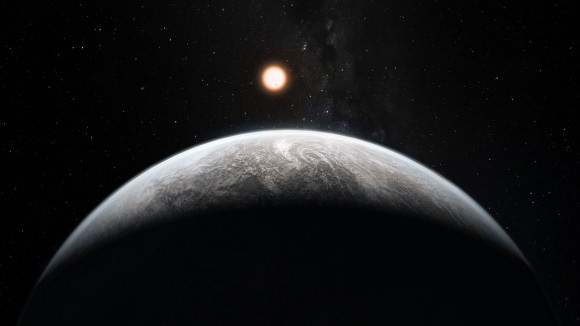
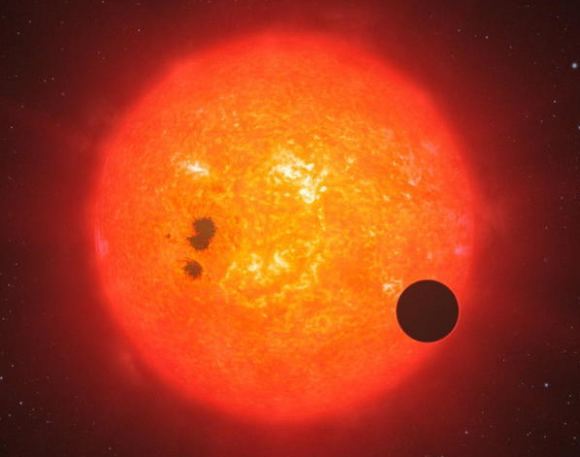
Two new Super-Earths Discovered Around a Red Dwarf Star The search for extra-solar planets has turned up some very interesting discoveries. Aside planets that are more-massive versions of their Solar counterparts (aka. Super-Jupiters and Super-Earths), there have been plenty of planets that straddle the line between classifications. And then there were times when follow-up observations have led to the discovery of multiple planetary systems. This was certainly the case when it came to K2-18, a red dwarf star system located about 111 light-years from Earth in the constellation Leo. Using the ESO’s High Accuracy Radial Velocity Planet Searcher (HARPS), an international team of astronomers wasRead More →
(Phys.org)—An international team of astronomers has detected a new thin stellar stream in the halo of the Milky Way galaxy. The newly discovered feature, named “jet stream,” could help researchers answer fundamental questions about the mass distribution of the Milky Way’s dark matter halo. The finding was presented November 24 in a paper published on the arXiv pre-print server. Powered by WPeMaticoRead More →

When a massive star dies, its core contracts. In a supernova explosion, the star’s outer layers are expelled, leaving behind an ultra-compact neutron star. For the first time, the LIGO and Virgo Observatories have recently been able to observe the merger of two neutron stars and measure the mass of the merging stars. Together, the neutron stars had a mass of 2.74 solar masses. Based on these observational data, an international team of scientists from Germany, Greece, and Japan including HITS astrophysicist Dr. Andreas Bauswein has managed to narrow down the size of neutron stars with the aid of computer simulations. The calculations suggest thatRead More →

What is the Transit Method? For centuries, astronomers have speculated about the existence of planets beyond our Solar System. After all, with between 100 and 400 billion stars in the Milky Way Galaxy alone, it seemed unlikely that ours was the only one to have a system of planets. But it has only been within the past few decades that astronomers have confirmed the existence of extra-solar planets (aka. exoplanets). Astronomers use various methods to confirm the existence of exoplanets, most of which are indirect in nature. Of these, the most widely-used and effective to date has been Transit Photometry, a method that measures theRead More →

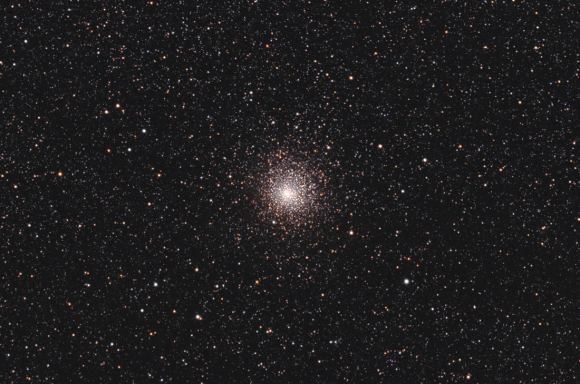
Messier 62 – the NGC 6266 Globular Cluster Welcome back to Messier Monday! Today, we continue in our tribute to our dear friend, Tammy Plotner, by looking at the globular cluster known as Messier 62. In the 18th century, while searching the night sky for comets, French astronomer Charles Messier kept noting the presence of fixed, diffuse objects he initially mistook for comets. In time, he would come to compile a list of approximately 100 of these objects, hoping to prevent other astronomers from making the same mistake. This list – known as the Messier Catalog – would go on to become one of theRead More →

Taking a picture of an exoplanet—a planet in a solar system beyond our sun—is no easy task. The light of a planet’s parent star far outshines the light from the planet itself, making the planet difficult to see. While taking a picture of a small rocky planet like Earth is still not feasible, researchers have made strides by snapping images of about 20 giant planet-like bodies. These objects, known as planetary-mass companions, are more massive than Jupiter, orbit far from the glare of their stars, and are young enough to still glow with heat from their formation—all traits that make them easier to photograph. PoweredRead More →

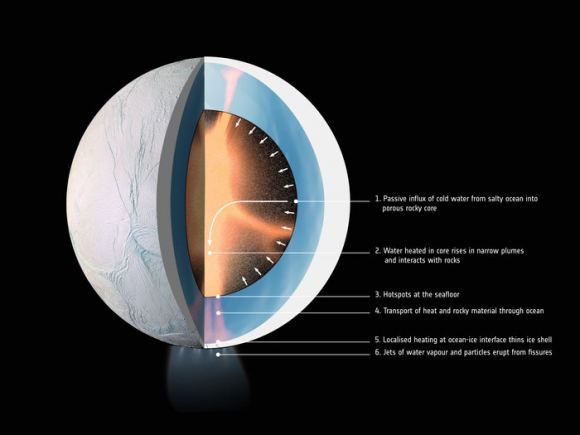
In the hunt for extra-terrestrial life, scientists tend to take what is known as the “low-hanging fruit approach.” This consists of looking for conditions similar to what we experience here on Earth, which include at oxygen, organic molecules, and plenty of liquid water. Interestingly enough, some of the places where these ingredients are present in abundance include the interiors of icy moons like Europa, Ganymede, Enceladus and Titan. Powered by WPeMaticoRead More →

The path of a light beam will be bent by the presence of mass, an effect explained by General Relativity, and a massive body can therefore act like a lens – a so called “gravitational lens” – to distort the image of an object seen behind it. Scientists first confirmed this prediction quantitatively during the now famous total eclipse of 29 May 1919 by observing starlight bent by the mass of the sun. Microlensing is the name given to a related phenomenon: the short flash of light produced when a cosmic body, acting as a gravitational lens, changes the intensity of visible light from aRead More →

(Phys.org)—A new study based on observations conducted via the Zurich imaging polarimeter (ZIMPOL) reveals insights into the nature of a protoplanetary disc surrounding the star HD 169142. The research, presented in a paper published November 24 on arXiv.org, uncovers sub-structures and offsets in the dust distribution of the inner part of the disc. Powered by WPeMaticoRead More →

When galaxy clusters and globular star clusters form, a phenomenon called “violent relaxation” occurs. After interacting intensely, the thousands or even millions of bodies reach a state of relative gravitational equilibrium and a fairly long-lasting spatial distribution. Powered by WPeMaticoRead More →

A New Survey Takes the Hubble Deep Field to the Next Level, Analyzing Distance and Properties of 1,600 Galaxies Since its deployment in 1990, the Hubble Space Telescope has given us some of the richest and most detailed images of our Universe. Many of these images were taken while observing a patch of sky located in the Fornax constellation between September 2003 and January 2004. This region, known as the Hubble Ultra Deep Field (HUDF), contains an estimated 10,000 galaxies, all of which existed roughly 13 billion years ago. Looking to this region of space, multiple teams of astronomers used the MUSE instrument on theRead More →

There Could be Hundreds More Icy Worlds with Life Than on Rocky Planets Out There in the Galaxy In the hunt for extra-terrestrial life, scientists tend to take what is known as the “low-hanging fruit approach”. This consists of looking for conditions similar to what we experience here on Earth, which include at oxygen, organic molecules, and plenty of liquid water. Interestingly enough, some of the places where these ingredients are present in abundance include the interiors of icy moons like Europa, Ganymede, Enceladus and Titan. Whereas there is only one terrestrial planet in our Solar System that is capable of supporting life (Earth), thereRead More →

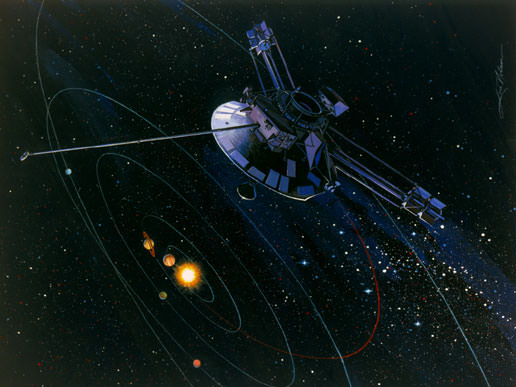
Juno Isn’t Exactly Where it’s Supposed To Be. The Flyby Anomaly is Back, But Why Does it Happen? In the early 1960s, scientists developed the gravity-assist method, where a spacecraft would conduct a flyby of a major body in order to increase its speed. Many notable missions have used this technique, including the Pioneer, Voyager, Galileo, Cassini, and New Horizons missions. In the course of many of these flybys, scientists have noted an anomaly where the increase in the spacecraft’s speed did not accord with orbital models. This has come to be known as the “flyby anomaly”, which has endured despite decades of study andRead More →

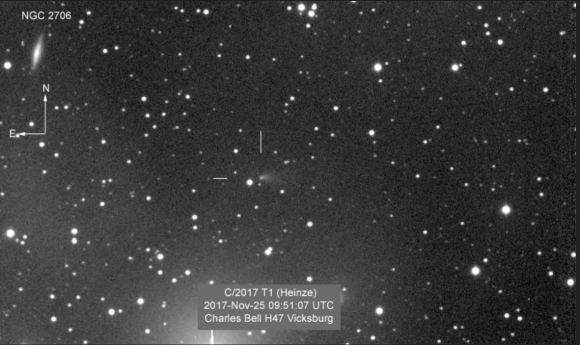
Here Comes Comet Heinze for the Holidays Comet C/2017 T1 Heinze passes near the galaxy NGC 2706 on November 25th. Image credit and copyright: Charles Bell. Yeah, we’re still all waiting for that next great “Comet of the Century” to make its presence known. In the meantime, we’ve had a steady stream of good binocular comets over the past year both expected and new, including Comet C/2017 O1 ASASSN1, 45/P Honda-Mrkos-Pajdušáková and Comet 41P Tuttle-Giacobini-Kresák (links). Now, another newcomer is set to bring 2017 in over the finish line. The Discovery: Astronomer Aren Heinze discovered Comet C/2017 T1 Heinze as a tiny +18th magnitude fuzzballRead More →

Molecular clouds in interstellar space can sometimes produce natural masers (the radio wavelength analogs of lasers) that shine with bright, narrow beams of radiation. Regions of active star formation generate some of the most spectacular such masers—in one case radiating as much energy in a single spectral line as does our Sun in its entire visible spectrum. In these sources, the maser radiation comes from molecules like water or OH that are excited by collisions and the radiation environment around the young stars. Powered by WPeMaticoRead More →

Oops, low energy LEDs are increasing light pollution When it comes to technology and the environment, it often seems like it’s “one step forward, two steps back.” Basically, sometimes the new and innovative technologies that are intended correct for one set of problems inevitably lead to new ones. This appears to be the case with the transition to solid-state lighting technology, aka. the “lighting revolution”. Basically, as nations transition from traditional lights to the energy-saving Light-Emitting Diodes (LEDs), there is the potential for a rebound effect. According to an international study led by Christopher Kyba from the GFZ German Research Center for Geoscience, the widespreadRead More →

Is there life beyond Earth in the cosmos? Astronomers looking for signs have found that our Milky Way galaxy teems with exoplanets, some with conditions that could be right for extraterrestrial life. Such worlds orbit stars in so-called “habitable zones,” regions where planets could hold liquid water that is necessary for life as we know it. Powered by WPeMaticoRead More →