Not long after the Big Bang, the first generations of stars began altering the chemical make-up of primitive galaxies, slowly enriching the interstellar medium with basic elements such as oxygen, carbon, and nitrogen. Finding the earliest traces of these common elements would shed important light on the chemical evolution of galaxies, including our own. Powered by WPeMaticoRead More →

Interview With Dr. Alan Stern and Dr. David Grinspoon, Authors of Chasing Pluto I was fortunate enough to spend half an hour with Dr. Alan Stern and Dr. David Grinspoon to talk about their new book: Chasing New Horizons – Inside the Epic First Mission to Pluto. We had a great conversation, all about the political and engineering hurdles it took to get the mission literally off the ground, and out to Pluto. We also talked about what future missions could be in the works to return to Pluto, the amazing recent discoveries made at the Pluto system, and the next target for New Horizons.Read More →

If There is a Multiverse, Can There be Life There Too? The Multiverse Theory, which states that there may be multiple or even an infinite number of Universes, is a time-honored concept in cosmology and theoretical physics. While the term goes back to the late 19th century, the scientific basis of this theory arose from quantum physics and the study of cosmological forces like black holes, singularities, and problems arising out of the Big Bang Theory. One of the most burning questions when it comes to this theory is whether or not life could exist in multiple Universes. If indeed the laws of physics changeRead More →

A group of scientists led by Avrajit Bandyopadhyay of the Indian Institute of Astrophysics, Bangalore, has conducted chemical analysis of two bright, extremely metal-poor stars. The results of the analysis, presented May 6 in a paper published on arXiv.org, provide important insights into the nature of these stars, and could help astronomers better understand their origin. Powered by WPeMaticoRead More →

A team of researchers at the Instituto de Astrofísica de Canarias (IAC) and at the National Astronomical Observatories of Beijing (NAOC) have published a paper which suggests that if we could travel at the speed of light it would take us 200,000 years to cross the disc of our galaxy. Powered by WPeMaticoRead More →

Nicholas Warner wants to figure out how matter behaves at the most extreme frontier of the universe. Warner, professor of physics and astronomy and mathematics at USC Dornsife, recently received a prestigious grant from the European Research Council to study a problem first revealed by Stephen Hawking—the black hole information paradox. Powered by WPeMaticoRead More →

Pros and Cons of Various Methods of Interstellar Travel It’s a staple of science fiction, and something many people have fantasized about at one time or another: the idea of sending out spaceships with colonists and transplanting the seed of humanity among the stars. Between discovering new worlds, becoming an interstellar species, and maybe even finding extra-terrestrial civilizations, the dream of  spreading beyond the Solar System is one that can’t become reality soon enough! For decades, scientists have contemplated how humanity might one-day reach achieve this lofty goal. And the range of concepts they have come up with present a whole lot of pros andRead More →

Carnival of Space #561 This week’s Carnival of Space is hosted by Brian Wang at his NextBigCoins blog. Click here to read Carnival of Space #561 And if you’re interested in looking back, here’s an archive to all the past Carnivals of Space. If you’ve got a space-related blog, you should really join the carnival. Just email an entry to susie@wshcrew.space, and the next host will link to it. It will help get awareness out there about your writing, help you meet others in the space community – and community is what blogging is all about. And if you really want to help out, sign up to beRead More →

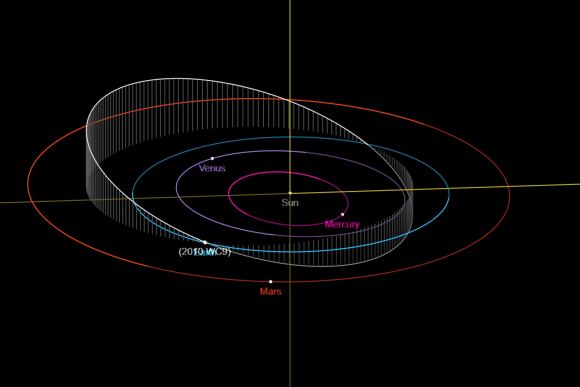
Recovered Asteroid 2010 WC9 Set to Buzz the Earth Tomorrow The orbit of asteroid 2010 WC9. Credit: NASA/JPL Incoming: The Earth-Moon system has company tonight. The Asteroid: Near Earth Asteroid 2010 WC9 is back. Discovered by the Catalina Sky Survey outside Tucson, Arizona on November 30th, 2010, this asteroid was lost after a brief 10 day observation window and was not recovered until just earlier this month. About 71 meters in size, 2010 WC9 is one of the largest asteroids to pass us closer than the Earth-Moon distance. A closeup of the passage of asteroid 2010 WC9 through the Earth-Moon system on May 15th. Credit:Read More →

Using European Southern Observatory’s Very Large Telescope (VLT) European astronomers have uncovered a complex circumstellar environment of the star HD 50138. The finding, which could provide important clues about the evolutionary status of this star, was presented in a paper published May 3 on the arXiv pre-print repository. Powered by WPeMaticoRead More →

At first glance, this image may resemble red ink filtering through water or a crackling stream of electricity, but it is actually a unique view of our cosmic home. It reveals the central plane of the Milky Way as seen by ESA’s Planck satellite and the Atacama Pathfinder Experiment (APEX), which is located at an altitude of around 5100m in the Chilean Andes and operated by the European Southern Observatory. Powered by WPeMaticoRead More →

This week marks the twentieth anniversary of “first light” for the telescope behind the Sloan Digital Sky Survey (SDSS), which has gone on to create by far the largest three-dimensional map of the Universe ever made. Early in the morning of May 10th, 1998, the observers and engineers pointed the Sloan Foundation Telescope to the celestial equator and light went through to the survey’s exquisitely sensitive camera. When dawn broke after a long night’s work, SDSS observer Dan Long emailed his usual observer’s log summarizing what happened. After describing the technical details of the observations, and before noting a series of newly identified problems toRead More →

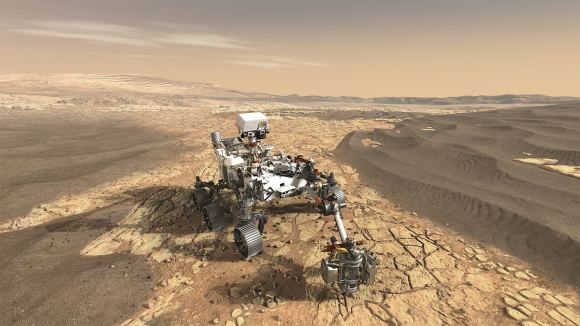
NASA is Sending a Helicopter to Mars as Part of the 2020 Rover At present, there are over a dozen robotic missions exploring the atmosphere and surface of Mars. These include, among others, the Curiosity rover, the Opportunity rover, the Mars Orbiter Mission (MOM), the Mars Reconnaissance Orbiter (MRO), the Mars Atmosphere and Volatile EvolutioN (MAVEN) orbiter, and the soon-to-arrive InSight Lander. In the coming decade, many more missions are planned. For instance, NASA plans to expand on what Curiosity has accomplished by sending the Mars 2020 rover to conduct a sample-return mission. According to a recent announcement issued by NASA, this mission will also includeRead More →

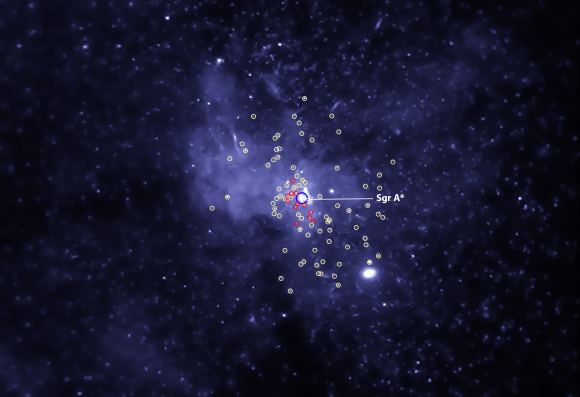
Evidence for Thousands of Black Holes Buzzing Around the Center of the Milky Way Since the 1970s, astronomers have understood that a Supermassive Black Hole (SMBH) resides at the center of the Milky Way Galaxy. Located about 26,000 light-years from Earth between the Sagittarius and Scorpius constellations, this black hole has come to be known as Sagittarius A* (Sgr A*). Measuring 44 million km across, this object is roughly 4 million times as massive as our Sun and exerts a tremendous gravitational pull. Since that time, astronomers have discovered that most massive galaxies have SMBHs at their core, which is what separates those that haveRead More →