Weekly Space Hangout: May 9, 2018: Tom Bridgman of NASA’s Scientific Visualization Studio Hosts: Fraser Cain (universetoday.com / @fcain) Dr. Paul M. Sutter (pmsutter.com / @PaulMattSutter) Dr. Kimberly Cartier (KimberlyCartier.org / @AstroKimCartier ) Dr. Morgan Rehnberg (MorganRehnberg.com / @MorganRehnberg & ChartYourWorld.org) Special Guests: Tom Bridgman works at NASA’s Scientific Visualization Studio (SVS) creating amazing data-driven visual content using space science data from NASA initiatives for education and public outreach. After earning his PhD in physics and astronomy, Tom worked as an instrument specialist at the Compton Gamma-Ray Observatory before joining the SVS at Goddard. You can learn all about the SVS at their webpage. YouRead More →
Researchers at the University of Southampton have discovered that the unique ‘Bursting Pulsar’ – a neutron star which steals matter from a low-mass stellar neighbour – may also be the slowest known ‘transitional pulsar’ in existence. Transitional pulsars are a rare class of neutron stars, which alternate between showing X-ray and radio pulsations over timescales of years. Powered by WPeMaticoRead More →

Exiled Asteroid Discovered in Outer Reaches of Solar System An international team of astronomers has used ESO telescopes to investigate a relic of the primordial Solar System. The team found that the unusual Kuiper Belt Object 2004 EW95 is a carbon-rich asteroid, the first of its kind to be confirmed in the cold outer reaches of the Solar System. This curious object likely formed in the asteroid belt between Mars and Jupiter and has been flung billions of kilometres from its origin to its current home in the Kuiper Belt. ESO News Feed Go to Source Powered by WPeMaticoRead More →

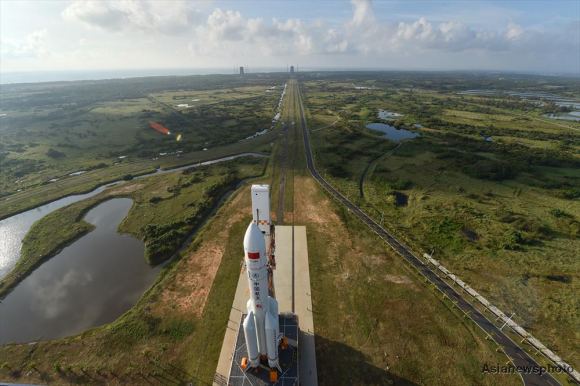
China is Working on Their Own Reusable Rocket: the First Stage of the Long March-8, Which Could Launch in 2021 In recent decades, China’s space program has advanced considerably. In addition to deploying their first space station (Tiangong-1) and developing a modern rockets (the Long March 5), the nation has also sent robotic mission to the lunar surface and plans to conduct crewed missions there in the coming years. To this end, China is looking to create a new series of rockets that will enable them to explore the Moon and maybe even Mars. One of the rockets they use to accomplish these goals isRead More →

How Many of Earth’s Moons Crashed Back Into the Planet? For decades, scientists have pondered how Earth acquired its only satellite, the Moon. Whereas some have argued that it formed from material lost by Earth due to centrifugal force, or was captured by Earth’s gravity, the most widely accepted theory is that the Moon formed roughly 4.5 billion years ago when a Mars-sized object (named Theia) collided with a proto-Earth (aka. the Giant Impact Hypothesis). However, since the proto-Earth experienced many giant-impacts, several moons are expected to have formed in orbit around it over time. The question thus arises, what happened to these moons? RaisingRead More →

Breakthrough Listen – the initiative to find signs of intelligent life in the universe – announced today that a survey of millions of stars located in the plane of our galaxy, using the CSIRO Parkes Radio Telescope (“Parkes”) in New South Wales, Australia, has commenced. Listen observations at Parkes began in November 2016, targeting a sample consisting mostly of stars within a few light years of Earth. Now, observations have expanded to cover a huge swath of the Milky Way visible from the site. Powered by WPeMaticoRead More →

An international team of astronomers headed by Dutch researchers from Leiden University has coincidently found a small companion around the young double star CS Cha. The astronomers examined the dust disc of the binary, while they stumbled upon the companion. The researchers suspect that it is a planet in his toddler years that is still growing. The astronomers used the SPHERE instrument on the European Very Large Telescope in Chile. They will soon publish their findings in an article that is accepted by the journal Astronomy & Astrophysics. Powered by WPeMaticoRead More →

A team of scientists led by the Max Planck Institute for Solar System Research (MPS) and the University of Göttingen has discovered new waves of vorticity on the Sun. As described in today’s issue of Nature Astronomy, these Rossby waves propagate in the direction opposite to rotation, have lifetimes of several months, and maximum amplitudes at the Sun’s equator. For forty years scientists had speculated about the existence of such waves on the Sun, which should be present in every rotating fluid system. Now, they have been unambiguously detected and characterized for the first time. The solar Rossby waves are close relatives of the RossbyRead More →

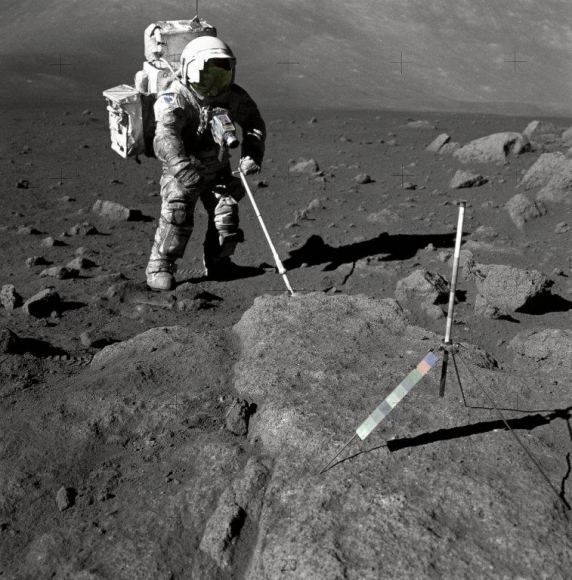
Breathing Lunar Dust Could Give Astronauts Bronchitis and Even Lung Cancer It’s been over forty years since the Apollo Program wrapped up and the last crewed mission to the Moon took place. But in the coming years and decades, multiple space agencies plan to conduct crewed missions to the lunar surface. These includes NASA’s desire to return to the Moon, the ESA’s proposal to create an international Moon village, and the Chinese and Russian plans to send their first astronauts to the Moon. For this reason, a great deal of research has been dedicated to what the health effects of long-duration missions to the MoonRead More →

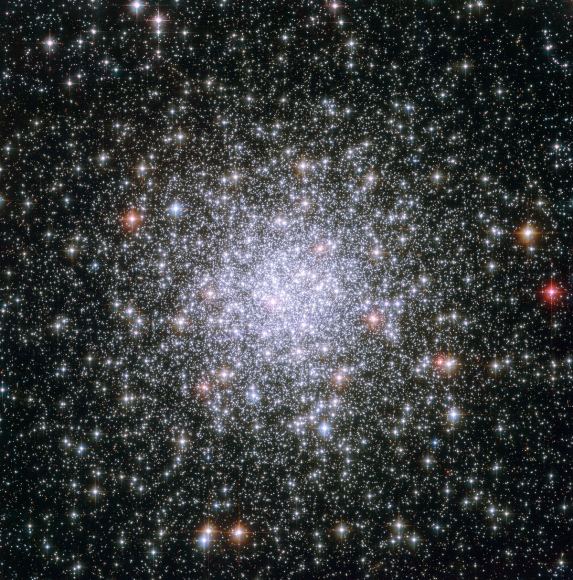
Messier 69 – the NGC 6637 Globular Cluster Welcome back to Messier Monday! Today, we continue in our tribute to our dear friend, Tammy Plotner, by looking at the globular cluster known as Messier 69. In the 18th century, while searching the night sky for comets, French astronomer Charles Messier kept noting the presence of fixed, diffuse objects he initially mistook for comets. In time, he would come to compile a list of approximately 100 of these objects, hoping to prevent other astronomers from making the same mistake. This list – known as the Messier Catalog – would go on to become one of theRead More →

Carnival of Space #560 This week’s Carnival of Space is hosted by Allen Versfeld at his Urban Astronomer blog. Click here to read Carnival of Space #560. And if you’re interested in looking back, here’s an archive to all the past Carnivals of Space. If you’ve got a space-related blog, you should really join the carnival. Just email an entry to susie@wshcrew.space, and the next host will link to it. It will help get awareness out there about your writing, help you meet others in the space community – and community is what blogging is all about. And if you really want to help out, sign upRead More →

Caffau’s star, the most metal-poor object known to date and one of the oldest stars in the Milky Way galaxy, turns out to be a dwarf star, according to an analysis of new measurements provided by Gaia Data Release 2 (DR2). The finding was detailed April 27 in a paper published on the arXiv pre-print server. Powered by WPeMaticoRead More →

Since the limited amount of gas that survived from the first bulk star-forming process will be quickly expelled within several million years, star clusters have long been thought of as “infertile” stellar systems that cannot form new stars. Only collisions or mergers of stars can lead to rejuvenation of much older stars, making them look younger than most normal stars in much the same way as humans apply facelifts. Powered by WPeMaticoRead More →

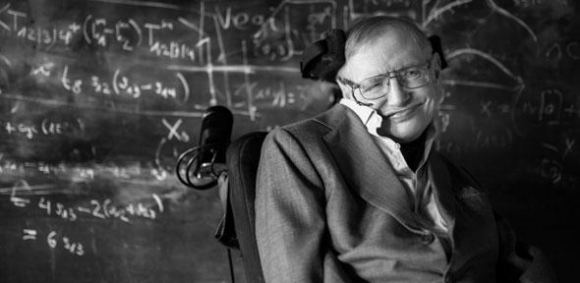
Here’s Stephen Hawking’s Final Theory About the Big Bang Stephen Hawking is rightly seen as one of the most influential scientists of our time. In his time on this planet, the famed physicist, science communicator, author and luminary became a household name, synonymous with the likes of Einstein, Newton and Galileo. What is even more impressive is the fact that he managed to maintain his commitment to science, education and humanitarian efforts despite suffering from a slow, degenerative disease. Even though Hawking recently passed away, his influence is still being felt. Shortly before his death, Hawking submitted a paper offering his final theory on theRead More →

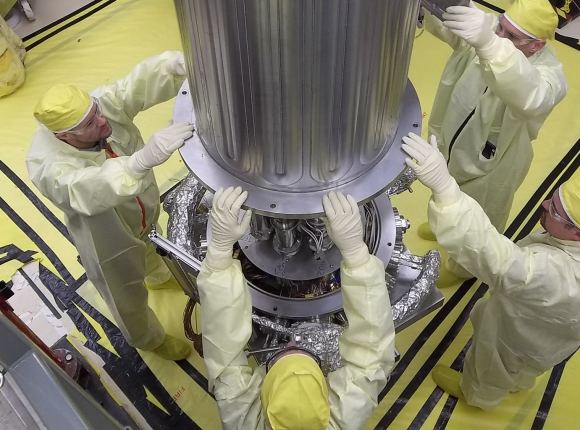
NASA Has Tested a New Fission Space Reactor that Could be Used in Future Missions Looking to the future of crewed space exploration, it is clear to NASA and other space agencies that certain technological requirements need to be met. Not only are a new generation of launch vehicles and space capsules needed (like the SLS and Orion spacecraft), but new forms of energy production are needed to ensure that long-duration missions to the Moon, Mars, and other locations in the Solar System can take place. One possibility that addresses these concerns is Kilopower, a lightweight fission power system that could power robotic missions, basesRead More →