The spots on the surface on the sun come and go with an 11-year periodicity known as the solar cycle. The solar cycle is driven by the solar dynamo, which is an interplay between magnetic fields, convection and rotation. However, our understanding of the physics underlying the solar dynamo is far from complete. One example is the so-called Maunder Minimum, a period in the 17th century, where spots almost disappeared from the surface of the sun for a period of over 50 years. Powered by WPeMaticoRead More →

The Gaia Mission Could Moonlight as a Gravitational Wave Detector In February of 2016, scientists working for the Laser Interferometer Gravitational-Wave Observatory (LIGO) made the first-ever detection of gravitational waves. Since that time, multiple detections have taken place, thanks in large to part to improvements in instruments and greater levels of collaboration between observatories. Looking ahead, its possible that missions not designed for this purpose could also “moonlight” as gravitational wave detectors. For example, the Gaia spacecraft – which is busy creating the most detailed 3D map of the Milky Way – could also be instrumental when it comes to gravitational wave research. That’s whatRead More →

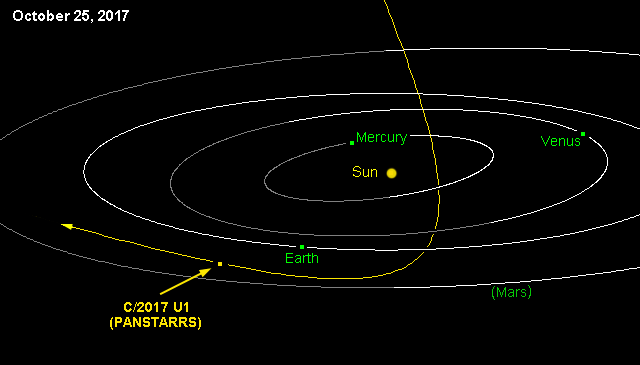
One of the highlights of 2017 was the discovery of the first object in our solar system that definitely came from somewhere else. At first we thought it was a comet, then an asteroid, and now the International Astronomical Union has reclassified it as something new entirely, an interstellar object. The Hawaiian astronomers who discovered it aptly named it ‘Oumuamua, which means “a messenger from afar arriving first”, reflecting that this object is like a scout sent from the past to reach out to us. Powered by WPeMaticoRead More →

Upcoming Chinese Lander Will Carry Insects and Plants to the Surface of the Moon It would be no exaggeration to say that we live in an age of renewed space exploration. In particular, the Moon has become the focal point of increasing attention in recent years. In addition to President Trump’s recent directive to NASA to return to the Moon, many other space agencies and private aerospace companies are planning their own missions to the lunar surface. A good example is the Chinese Lunar Exploration Program (CLEP), otherwise known as the Chang’e Program. Named in honor of the ancient Chinese lunar goddess, this program hasRead More →

Here’s the Earth and Moon Seen from OSIRIS-REx On September 8th, 2016, NASA’s Origins, Spectral Interpretation, Resource Identification, and Security-Regolith Explorer (OSIRIS-REx) mission was launched into space. In the coming months, this space probe will approach and then rendezvous with the asteroid 101955 Bennu – a Near-Earth Object (NEO) – for the sake of studying it. The mission will also acquire samples of the asteroid, which will be returned to Earth by 2023. The OSIRIS-REx mission is an historic one, since it will be the first spacecraft to conduct a sample-return mission with an asteroid. In the meantime, as the probe has makes its wayRead More →

Twinkle, twinkle, little star, how I wonder what you are. Astronomers are hopeful that the powerful infrared capability of NASA’s James Webb Space Telescope will resolve a puzzle as fundamental as stargazing itself—what IS that dim light in the sky? Brown dwarfs muddy a clear distinction between stars and planets, throwing established understanding of those bodies, and theories of their formation, into question. Powered by WPeMaticoRead More →

Astronomers have found a new eclipsing binary system by analyzing archival survey data and conducting follow-up radial velocity measurements. The newly found binary, designated SDSSJ1156-0207, is composed of two M-dwarf stars orbiting each other at a relatively close distance. The finding is presented in a paper published December 24 on the arXiv pre-print repository. Powered by WPeMaticoRead More →

Just as the sun is moving within the Milky Way, all the stars in galaxies are moving, but with very different orbits. Some of the stars have strong rotations, while others may be moving randomly with no clear rotation. Comparing the fraction of stars on different orbits, researchers can determine how galaxies form and evolve. An international team of astronomers has derived directly, for the first time, the orbital distribution of a galaxy sample containing more than 300 galaxies of the local universe. The results, published in Nature Astronomy, are based on the CALIFA survey, a project developed at Calar Alto Observatory and conceived fromRead More →

You Knew This Day Was Coming. Alien Megastructures Ruled Out for Tabby’s Star. Dust is the Culprit In September of 2015, KIC 8462852 (aka. Tabby’s Star) captured the world’s attention when it was found to be experiencing a mysterious drop in brightness. In the years since then, multiple studies have been conducted that have tried to offer a natural explanation for this behavior. In lieu of one, there’s been plenty of speculation as to what could be causing the dimming effect – including the controversial “alien megastructure” theory. Unfortunately, after years of excitement and speculation, the scientific community may have finally driven a nail intoRead More →

In mid-March, the Chinese Tiangong-1 Space Station is Going to Come Crashing Back Down to Earth… Somewhere In September of 2011, China officially joined the Great Powers in Space club, thanks to the deployment of their Tiangong-1 space station. Since then, this prototype station has served as a crewed orbital laboratory and an experimental testbed for future space stations. In the coming years, China hopes to build on the lessons learned with Tiangong-1 to create a larger, modular station in 2023 (similar to the International Space Station). Though the station’s mission was originally meant to end in 2013, the China National Space Agency extended itsRead More →

Weekly Space Hangout – Jan 3, 2018: Dr. Jeyhan Kartaltepe of the Cosmic Evolution Early Release Science (CEERS) Survey Hosts: Fraser Cain (universetoday.com / @fcain) Dr. Paul M. Sutter (pmsutter.com / @PaulMattSutter) Dr. Kimberly Cartier (KimberlyCartier.org / @AstroKimCartier ) Dr. Morgan Rehnberg (MorganRehnberg.com / @MorganRehnberg & ChartYourWorld.org) Special Guest: Dr. Jeyhan Kartaltepe is an Assistant Professor of Physics at Rochester Institute of Technology, and is the Deputy Director of the Laboratory for Multiwavelength Astrophysics. She is also a leading member of the Cosmic Evolution Early Release Science (CEERS) Survey team that has been selected as part of the James Webb Space Telescope Director’s Discretionary EarlyRead More →

Astronomers have presented the initial results of the Large Impact of Magnetic Fields on the Evolution of Hot Stars (LIFE) project. Among determining fundamental parameters of 15 stars, they found that two of them have magnetic fields. The finding is detailed in a paper published December 20 on arXiv.org. Powered by WPeMaticoRead More →

A team of more than 200 researchers, including Penn State Department of Astronomy and Astrophysics Assistant Professor Jason Wright and led by Louisiana State University’s Tabetha Boyajian, is one step closer to solving the mystery behind the “most mysterious star in the universe.” KIC 8462852, or “Tabby’s Star,” nicknamed after Boyajian, is otherwise an ordinary star, about 50 percent bigger and 1,000 degrees hotter than the Sun, and about than 1,000 light years away. However, it has been inexplicably dimming and brightening sporadically like no other. Several theories abound to explain the star’s unusual light patterns, including that an alien megastructure is orbiting the star.Read More →

At first glance, it would seem to be impossible to look inside a star. An international team of astronomers, under the leadership of Earl Bellinger and Saskia Hekker of the Max Planck Institute for Solar System Research in Göttingen, has, for the first time, determined the deep inner structure of two stars based on their oscillations. Powered by WPeMaticoRead More →

Supermassive black holes with millions or even billions of solar-masses of material are found at the nuclei of most galaxies, including our Milky Way. A torus of dust and gas orbits around the black hole (at least according to most theories) and radiates in ultraviolet light when material falling toward the black hole heats the disk to millions of degrees. The accretion process can also power the ejection of jets of rapidly moving charged particles. Such actively accreting supermassive black holes in galaxies are called active galactic nuclei (AGN). Powered by WPeMaticoRead More →

Supermassive Black Holes can Turn Star Formation On and Off in a Large Galaxy In the 1970s, astronomers discovered that a particularly large black hole (Sagittarius A*) existed at the center of our galaxy. In time, they came to understand that similar Supermassive Black Holes (SMBHs) existed in the center of most massive galaxies. The presence of these black holes was also what differentiated galaxies that had particularly luminous cores – aka. Active Galactic Nuclei (AGN) – from those that didn’t. Since that time, astronomers and cosmologists have pondered what role SMBHs have on galactic evolution, with some venturing that they have a profound impactRead More →