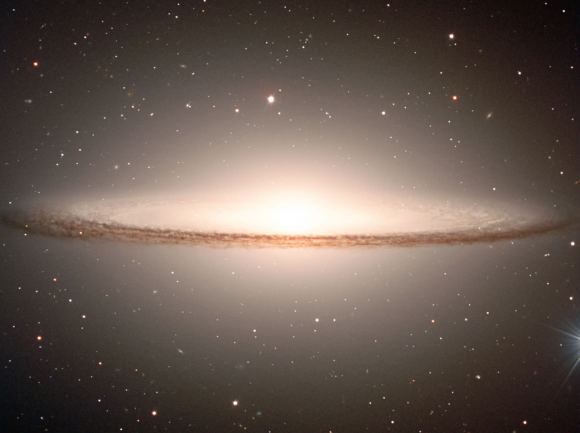
Supermassive Black Holes can Turn Star Formation On and Off in a Large Galaxy In the 1970s, astronomers discovered that a particularly large black hole (Sagittarius A*) existed at the center of our galaxy. In time, they came to understand that similar Supermassive Black Holes (SMBHs) existed in the center of most massive galaxies. The presence of these black holes was also what differentiated galaxies that had particularly luminous cores – aka. Active Galactic Nuclei (AGN) – from those that didn’t. Since that time, astronomers and cosmologists have pondered what role SMBHs have on galactic evolution, with some venturing that they have a profound impactRead More →

What is the Gravitational Microlensing Method? Welcome back to our series on Exoplanet-Hunting methods! Today, we look at the curious and unique method known as Gravitational Microlensing. The hunt for extra-solar planets sure has heated up in the past decade. Thanks to improvements made in technology and methodology, the number of exoplanets that have been observed (as of December 1st, 2017) has reached 3,710 planets in 2,780 star systems, with 621 system boasting multiple planets. Unfortunately, due to various limits astronomers are forced to contend with, the vast majority have been discovered using indirect methods. One of the more commonly-used methods for indirectly detecting exoplanetsRead More →

Carnival of Space #542 This week’s Carnival of Space is hosted by Brian Wang at his Next Big Future blog. Click here to read Carnival of Space #542 And if you’re interested in looking back, here’s an archive to all the past Carnivals of Space. If you’ve got a space-related blog, you should really join the carnival. Just email an entry to carnivalofspace@gmail.com, and the next host will link to it. It will help get awareness out there about your writing, help you meet others in the space community – and community is what blogging is all about. And if you really want to help out, sign upRead More →

Messier 64 – The Black Eye Galaxy Welcome back to Messier Monday! Today, we continue in our tribute to our dear friend, Tammy Plotner, by looking at that “evil” customer known as Messier 64 – aka. the “Black Eye Galaxy”! In the 18th century, while searching the night sky for comets, French astronomer Charles Messier kept noting the presence of fixed, diffuse objects he initially mistook for comets. In time, he would come to compile a list of approximately 100 of these objects, hoping to prevent other astronomers from making the same mistake. This list – known as the Messier Catalog – would go onRead More →

Top 2018 Astronomy Events 2018 Astronomy – The final occultation of the bright star Aldebaran by the Moon for 2017. Dave Dickinson Happy New Year 2018. One of the toughest choices we made last year was to not write a full astronomy guide for 2018. We’ve done this in one iteration or another now for about a decade, but an ongoing project (also astronomical in nature) has consumed most of our writing hours… but we recently realized that we can still take stock in what’s in the sky for the year ahead, and give you a sneak peek at part of our project for theRead More →

In Preparation for its Inaugural Launch, the Falcon Heavy Receives its Special Cargo – Musk’s Tesla Roadster! After years of preparation, SpaceX is gearing up for the inaugural launch of its Falcon Heavy rocket. As the name would suggest, this rocket is the heaviest launch vehicle in the SpaceX arsenal. With a payload capacity of 54 metric tons (119,000 lbs), it can lift over twice as much weight of the next heaviest launch vehicle (the ULA’s Delta IV Heavy). And in time, SpaceX hopes to use this rocket to send astronauts into orbit, to the Moon, and on to Mars. Basically, the Falcon Heavy isRead More →

An international team of astronomers reports the discovery of four new ‘hot Jupiter’ extrasolar worlds by the HATSouth survey. The newly found exoplanets received designations HATS-50b through HATS-53b. The finding is presented in a paper published December 12 on arXiv.org. Powered by WPeMaticoRead More →
Most galaxies lie in clusters containing from a few to thousands of objects. Our Milky Way, for example, belongs to a cluster of about fifty galaxies called the Local Group whose other large member is the Andromeda galaxy about 2.3 million light-years away. Clusters are the most massive gravitationally bound objects in the universe and form (according to current ideas) in a “bottoms-up” fashion with smaller structures developing first and larger groupings assembling later in cosmic history. Dark matter plays an important role in this growth process. Powered by WPeMaticoRead More →

Mysterious Filament is Stretching Down Towards the Milky Way’s Supermassive Black Hole The core of the Milky Way Galaxy has always been a source of mystery and fascination to astronomers. This is due in part to the fact that our Solar System is embedded within the disk of the Milky Way – the flattened region that extends outwards from the core. This has made seeing into the bulge at the center of our galaxy rather difficult. Nevertheless, what we’ve been able to learn over the years has proven to be immensely interesting. For instance, in the 1970s, astronomers became aware of the Supermassive Black HoleRead More →

Just a Billion Years After the Earth Formed, Life had Already Figured out Plenty of Tricks Life on Earth has had a long and turbulent history. Scientists estimate that roughly 4 billion years ago, just 500 million years after planet Earth formed, the first single-celled lifeforms arose. By the Archean Eon (4 to 2.5 billion years ago), multi-celled lifeforms are believed to have emerged. While the existence of such organisms (Archaea) has been inferred from carbon isotopes found in ancient rocks, fossil evidence has remained elusive. All of that has changed, thanks to a recent study performed by a team of researchers from UCLA andRead More →

What is the Radial Velocity Method? Welcome back to our series on Exoplanet-Hunting methods! Today, we look at another widely-used and popular method of exoplanet detection, known as the Radial Velocity (aka. Doppler Spectroscopy) Method. The hunt for extra-solar planets sure has heated up in the past decade or so! Thanks to improvements made in instrumentation and methodology, the number of exoplanets discovered (as of December 1st, 2017) has reached 3,710 planets in 2,780 star systems, with 621 system boasting multiple planets. Unfortunately, due to the limits astronomers are forced to contend with, the vast majority have been discovered using indirect methods. When it comesRead More →

Yes Please! NASA is Considering a Helicopter Mission to Titan The only thing cooler than sending a helicopter drone to explore Titan is sending a nuclear powered one to do the job. Called the “Dragonfly” spacecraft, this helicopter drone mission has been selected as one of two finalists for NASA’s robotic exploration missions planned for the mid 2020’s. NASA selected the Dragonfly mission from 12 proposals they were considering under their New Horizons program. Titan is Saturn’s largest moon, and is a primary target in the search for life in our Solar System. Titan has liquid hydrocarbon lakes on its surface, a carbon-rich chemistry, andRead More →

Astronomers Figure Out a New Way to Search for Planets at Alpha Centauri At a distance of 4.37 light-years from Earth, Alpha Centauri is the nearest star system to our own. For generations, scientists and speculative thinkers have pondered whether it might have a planetary system like our own Sun, and whether or not life may also exist there. Unfortunately, recent efforts to locate extra-solar planets in this star system have failed, with potential detections later shown to be the result of artifacts in the data. In response to these failed efforts, several more ambitious projects are being developed to find exoplanets around Alpha Centauri.Read More →

Maybe Mars and Earth Didn’t Form Close to Each Other In recent years, astronomers have been looking to refine our understanding of how the Solar System formed. On the one hand, you have the traditional Nebular Hypothesis which argues that the Sun, the planets, and all other objects in the Solar System formed from nebulous material billions of years ago. However, astronomers traditionally assumed that the planets formed in their current orbits, which has since come to be questioned. This has come to be challenged by theories like the Grand Tack model. This theory states that Jupiter migrated from its original orbit after it formed,Read More →