NASA’s Tess spacecraft embarks on quest to find new planets
2018-04-19
NASA’s Tess spacecraft embarked Wednesday on a quest to find new worlds around neighboring stars that could support life. Powered by WPeMaticoRead More →
NASA’s Tess spacecraft embarked Wednesday on a quest to find new worlds around neighboring stars that could support life. Powered by WPeMaticoRead More →
Musk Says that SpaceX will use a Giant Party Balloon to Bring an Upper Stage Back. Wait, what? When Elon Musk of SpaceX tweets something interesting, it generates a wave of excitement. So when he tweeted recently that SpaceX might be working on a way to retrieve upper stages of their rockets, it set off a chain of intrigued responses. SpaceX will try to bring rocket upper stage back from orbital velocity using a giant party balloon — Elon Musk (@elonmusk) April 15, 2018 SpaceX has been retrieving and reusing their lower stages for some time now, and it’s lowered the cost of launching payloadsRead More →
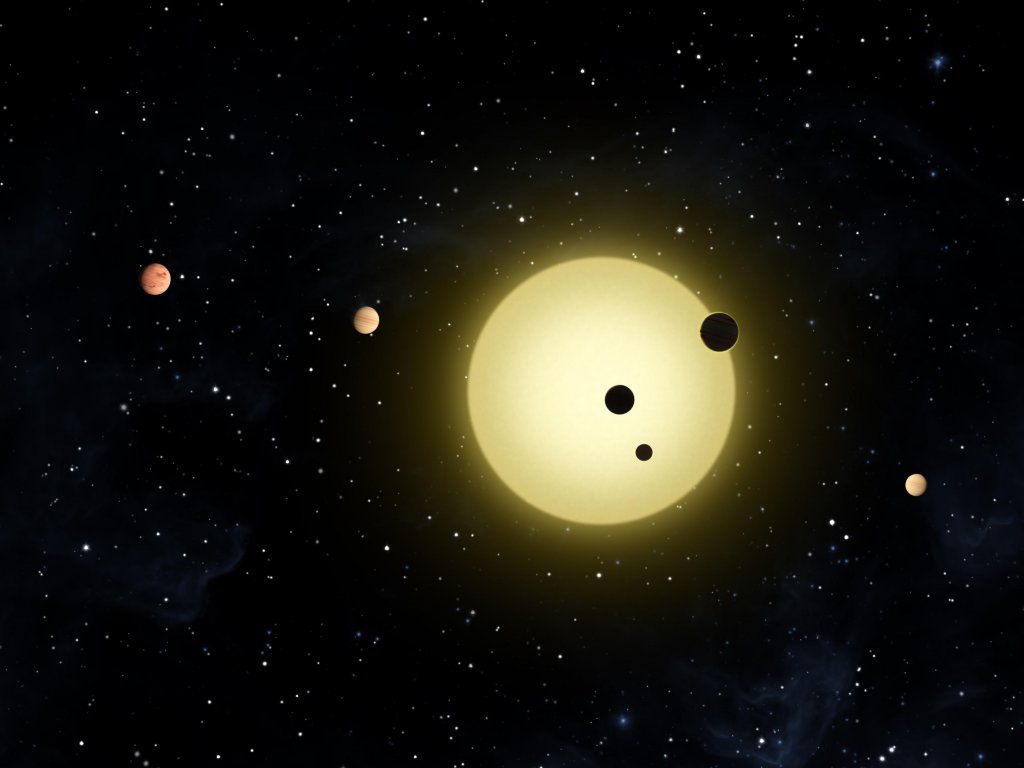
Farewell Kepler. Welcome TESS At 6:51 EDT on Wednesday, April 18th, a SpaceX Falcon 9 rocket blasted off from Florida’s Cape Canaveral. It was carrying NASA’s TESS: the Transiting Exoplanet Survey Satellite. From what we can tell, the mission went without a hitch, with the first stage returning to land on its floating barge in the Atlantic Ocean, and stage 2 carrying on to send TESS into its final orbit. This is a changing of the guard, as we’re now entering the final days for NASA’s Kepler Space Telescope. It’s running out of fuel and already crippled by the loss of its reaction wheels. InRead More →
Weekly Space Hangout: April 18, 2018: Kevin Gill: Art and Science from Juno and MRO Hosts: Fraser Cain (universetoday.com / @fcain) Dr. Paul M. Sutter (pmsutter.com / @PaulMattSutter) Dr. Kimberly Cartier (KimberlyCartier.org / @AstroKimCartier ) Dr. Morgan Rehnberg (MorganRehnberg.com / @MorganRehnberg & ChartYourWorld.org) Special Guests: Kevin Gill is a software engineer, planetary and climate data wrangler, and a science data visualization artist. Kevin will be discussing his work with Juno and MRO images. Check out his work at his Flickr page: https://www.flickr.com/photos/kevinmgill/ and his tech blog Apoapsys: http://www.wthr.us/ Follow Kevin on Twitter at: https://twitter.com/kevinmgill and Instagram here: https://www.instagram.com/apoapsys/ Announcements: If you would like to joinRead More →
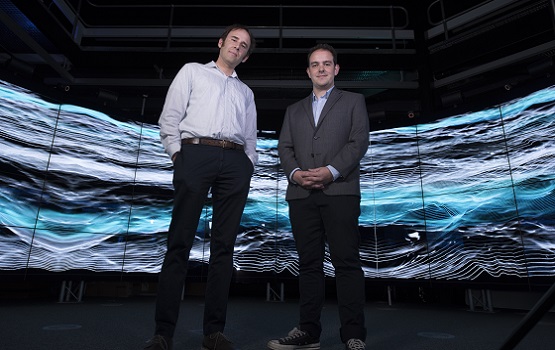
How to Listen to the Background Hum of Gravitational Waves From all the Black Holes Colliding into Each Other The first-ever detection of gravitational waves (which took place in September of 2015) triggered a revolution in astronomy. Not only did this event confirm a theory predicted by Einstein’s Theory of General Relativity a century before, it also ushered in a new era where the mergers of distant black holes, supernovae, and neutron stars could be studied by examining their resulting waves. In addition, scientists have theorized that black hole mergers could actually be a lot more common than previously thought. According to a new studyRead More →
Researchers at the University of Colorado Boulder have completed an unprecedented “dissection” of twin galaxies in the final stages of merging. Powered by WPeMaticoRead More →
An Australian-led group of astronomers working with European collaborators has revealed the “DNA” of more than 340,000 stars in the Milky Way, which should help them find the siblings of the Sun, now scattered across the sky. Powered by WPeMaticoRead More →
The NewSpace Revolution is About to Bring us Tiny Space Telescopes we can all Control One of the defining characteristics of the modern era of space exploration is the way the public and private aerospace companies (colloquially referred to as the NewSpace industry) and are taking part like never before. Thanks to cheaper launch services and the development of small satellites that can be built using off-the-shelf electronics (aka. CubeSats and microsats), universities and research institutions are also able to conduct research in space. Looking to the future, there are those who want to take public involvement in space exploration to a whole new level.Read More →
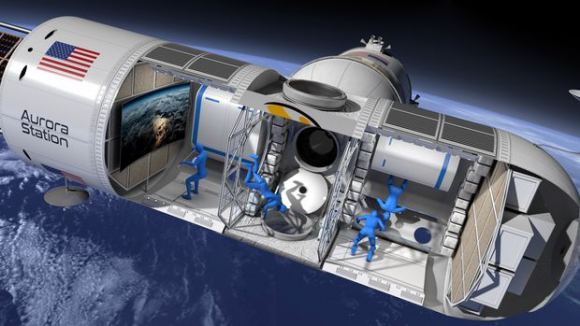
The Aurora Station Will be the First Luxury Hotel in Space Are you ready for a luxury hotel in space? We all knew it was coming, even though it seems impossibly futuristic. But this time it’s not just science fiction; somebody actually has a plan. The space hotel will be called “Aurora Station” and the company behind it is Orion Span, a Silicon Valley and Houston-based firm. Orion Span aims to deliver the astronaut experience to people, by delivering the people into space. The catch? “We developed Aurora Station to provide a turnkey destination in space. Upon launch, Aurora Station goes into service immediately, bringingRead More →
SpaceX postponed the launch of NASA’s new planet-hunting mission Monday in order to verify the Falcon 9 rocket’s navigation systems, the California-based company said. Powered by WPeMaticoRead More →
Carnival of Space #557 This week’s Carnival of Space is hosted by Gadi Eidelheit at his The Venus Transit blog. Click here to read Carnival of Space #557. And if you’re interested in looking back, here’s an archive to all the past Carnivals of Space. If you’ve got a space-related blog, you should really join the carnival. Just email an entry to susie@wshcrew.space, and the next host will link to it. It will help get awareness out there about your writing, help you meet others in the space community – and community is what blogging is all about. And if you really want to help out, signRead More →
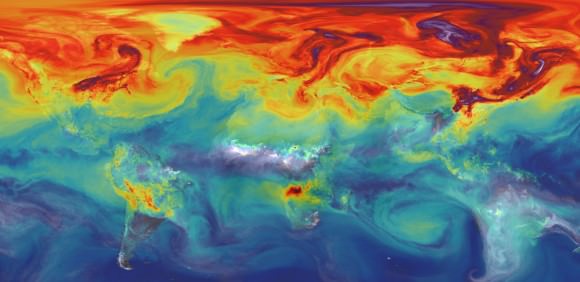
Could We Detect an Ancient Industrial Civilization in the Geological Record? As a species, we humans tend to take it for granted that we are the only ones that live in sedentary communities, use tools, and alter our landscape to meet our needs. It is also a foregone conclusion that in the history of planet Earth, humans are the only species to develop machinery, automation, electricity, and mass communications – the hallmarks of industrial civilization. But what if another industrial civilization existed on Earth millions of years ago? Would we be able to find evidence of it within the geological record today? By examining theRead More →
Imagine if, many millions of years ago, dinosaurs drove cars through cities of mile-high buildings. A preposterous idea, right? Over the course of tens of millions of years, however, all of the direct evidence of a civilization—its artifacts and remains—gets ground to dust. How do we really know, then, that there weren’t previous industrial civilizations on Earth that rose and fell long before human beings appeared? Powered by WPeMaticoRead More →
In recent history, a very important achievement was the discovery, in 1995, of 51 Pegasi b, the first extrasolar planet ever found around a normal star other than the Sun. Powered by WPeMaticoRead More →
University of Miami astrophysicist Nico Cappelluti studies the sky. An assistant professor in the Physics Department, Cappelluti is intrigued by the cosmic phenomena of super massive black holes, the nature of dark matter, and active galactic nuclei, which is the very bright light source found at the center of many galaxies. Powered by WPeMaticoRead More →
Are we alone? NASA’s new planet-hunting mission, poised to launch Monday, aims to advance the search for extraterrestrial life by scanning the skies for nearby, Earth-like planets. Powered by WPeMaticoRead More →
A “core-collapse” supernova occurs when the iron core of a massive star collapses under the force of gravity and then rebounds, generating pressure waves and shocks that propagate outward. A superluminous supernovae is a rare class of core collapse supernovae whose luminosity, equal to 10-1000 billion suns, is too high to be powered by the usual process that drives supernovae, the radioactive decay of nickel (there is not enough nickel present to do it). The source of the energetics has been hotly contested, with suggestions including shocks from the ejected material or pulsating instabilities interacting with surrounding material. The most favored model, however, is theRead More →
Using radial velocity method a group of Japanese astronomers has found that two evolved stars, namely 24 Booties and Gamma Librae, are orbited by gas giant planets. They discovered that 24 Booties hosts one planet, while Gamma Librae is circled by two alien worlds. The finding is detailed in a paper published April 11 on arXiv.org. Powered by WPeMaticoRead More →
NASA is poised to launch a $337 million washing machine-sized spacecraft that aims to vastly expand mankind’s search for planets beyond our solar system, particularly closer, Earth-sized ones that might harbor life. Powered by WPeMaticoRead More →
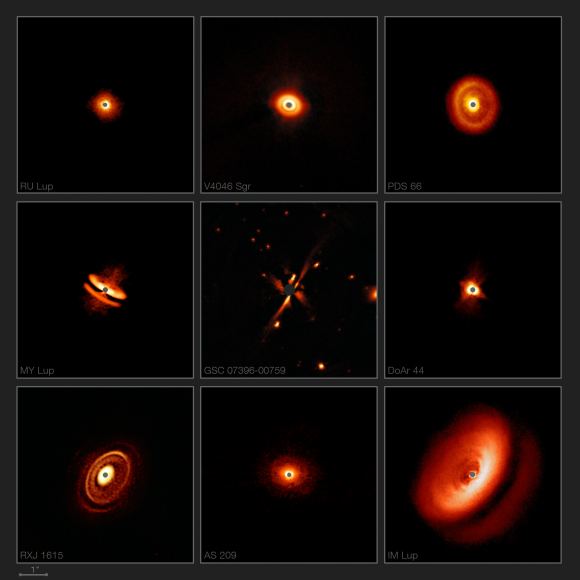
Look at This Fascinating Variety of Planet-Forming Disks Around Other Stars The European Southern Observatory (ESO) has released a stunning collection of images of the circumstellar discs that surround young stars. The images were captured with the SPHERE (Spectro-Polarimetric High-contrast Exoplanet REsearch) instrument on the ESO’s Very Large Telescope (VLT) in Chile. We’ve been looking at images of circumstellar disks for quite some time, but this collection reveals the fascinating variety of shapes an sizes that these disks can take. New images from the SPHERE instrument on ESO’s Very Large Telescope are revealing the dusty discs surrounding nearby young stars in greater detail than previouslyRead More →

