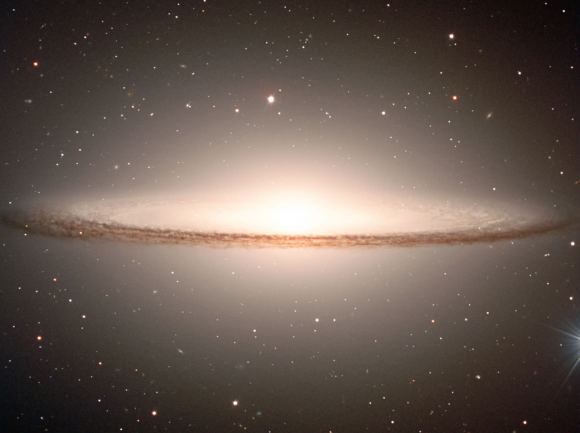
Globular Clusters Might not be as Old as Astronomers Thought. Like, Billions of Years Younger Globular clusters have been a source of fascination ever since astronomers first observed them in the 17th century. These spherical collections of stars are among the oldest known stars in the Universe, and can be found in the outer regions of most galaxies. Because of their age and the fact that almost all larger galaxies appear to have them, their role in galactic evolution has remained something of a mystery. Previously, astronomers were of the opinion that globular clusters were some of the earliest stars to have formed in theRead More →

Language in the Cosmos II: Hello There GJ273b The ‘Language in the Cosmos’ symposium Three times in October, 2017 researchers turned a powerful radar telescope near Tromsø, Norway towards an invisibly faint star in the constellation Canis Minor (the small dog) and beamed a coded message into space in an attempt to signal an alien civilization. This new attempt to find other intelligent life in the universe was reported in a presentation at the ‘Language in the Cosmos’ symposium held on May 26 in Los Angeles, California. METI International sponsored the symposium. This organization was founded to promote messaging to extraterrestrial intelligence (METI) as aRead More →

Join Fraser and Dr. Paul Sutter to Tour Costa Rica in March, 2019 Got any holiday plans in March, 2019? Why don’t you join me and Dr. Paul Sutter for a trip to Costa Rica. I’ve been to Costa Rica once before, and I was amazed by the amount of wildlife and biodiversity of this amazing country – I can’t wait to go back. In the daytime we saw hummingbirds, toucans, macaws and all kinds of monkeys. At night the jungles come alive with sights and sounds if you’re brave enough to explore them. There’s so much history around every corner, and the night skiesRead More →

Here’s the First Image From NOAA’s New Weather Satellite On March 1st, 2018, the GOES-17 weather satellite launched from Cape Canaveral Air Force Station in Florida. As a second generation GOES satellite operated by the National Oceanic and Atmospheric Administration, this and other satellites will extend the Geostationary Operational Environmental Satellite system’s (GOES) weather forecasting and meteorological research until 2036. The purpose of this new generation of satellites is to improve the forecasts of weather, oceans, the environment and space weather by providing faster and more detailed data, real-time images, and advanced monitoring. Recently, the satellite’s Advanced Baseline Imager (ABI) made its debut by releasingRead More →

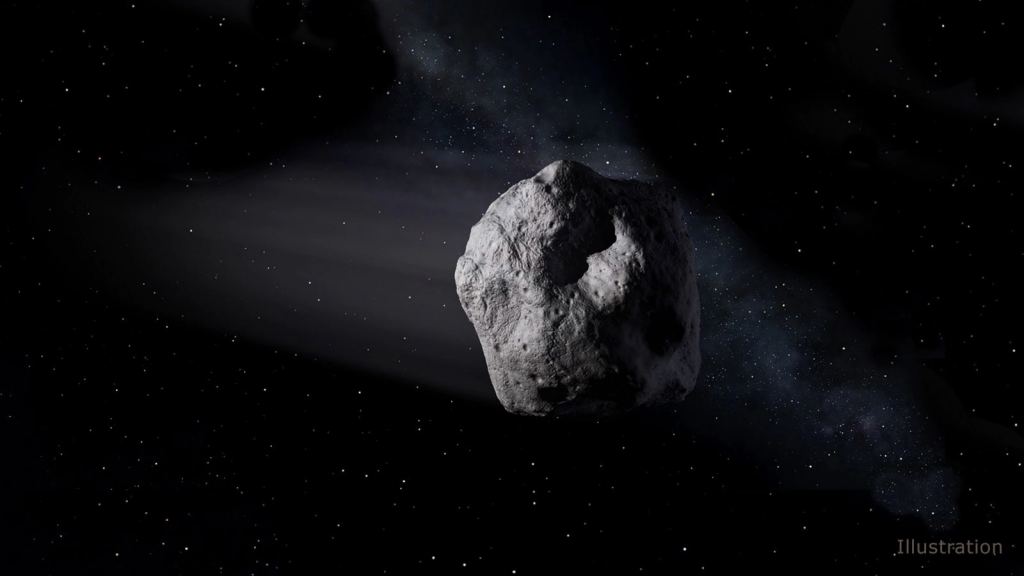
An Asteroid was Discovered Just Hours Before it Exploded over Africa On Saturday, June 2nd, skywatchers in Botswana reported an extremely bright fireball in the sky. A 2-meter-sized spacerock smashed into the atmosphere going 17 kilometers per second, disintegrated high in the atmosphere, and briefly lit up the landscape. BREAKING NEWS!! ??An #asteroid just hit Earth’s atmosphere, sparking a fireball over the southern African nation of Botswana at 12:44 p.m. EDT while hurtling down at a whopping 38,000 mph ? That’s 10 miles every second, but don’t worry, it burned up in the atmosphere (phew) pic.twitter.com/T5gGR1OHJN — Link Institute (@LinkObservatory) June 5, 2018 This kindRead More →

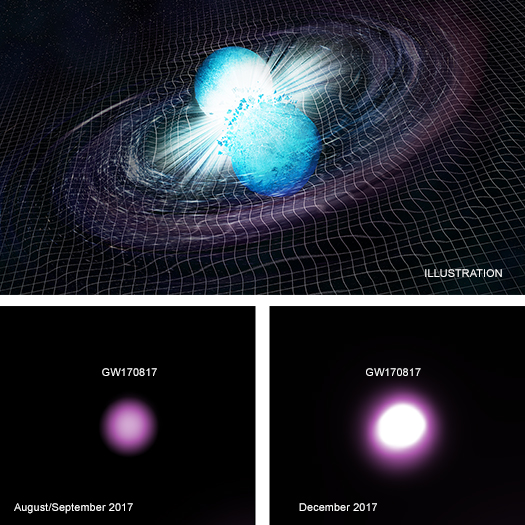
Okay, Last Year’s Kilonova Did Probably Create a Black Hole In August of 2017, another major breakthrough occurred when the Laser Interferometer Gravitational-Wave Observatory (LIGO) detected waves that were believed to be caused by a neutron star merger. Shortly thereafter, scientists at LIGO, Advanced Virgo, and the Fermi Gamma-ray Space Telescope were able to determine where in the sky this event (known as a kilonova) occurred. This source, known as GW170817/GRB, has been the target of many follow-up surveys since it was believed that the merge could have led to the formation of a black hole. According to a new study by a team thatRead More →

Carnival of Space #564 This week’s Carnival of Space is hosted by Brian Wang at his NextBigCoins blog. Click here to read Carnival of Space #564 And if you’re interested in looking back, here’s an archive to all the past Carnivals of Space. If you’ve got a space-related blog, you should really join the carnival. Just email an entry to susie@wshcrew.space, and the next host will link to it. It will help get awareness out there about your writing, help you meet others in the space community – and community is what blogging is all about. And if you really want to help out, sign up to beRead More →

Pluto has “Sand Dunes”, but Instead of Sand, it’s Grains of Frozen Methane In July of 2015, the New Horizons mission made history when it conducted the first flyby in history of Pluto. In the course of conducting its flyby, the probe gathered volumes of data about Pluto’s surface, composition, atmosphere and system of moons. It also provided breathtaking images of Pluto’s “heart”, its frozen plains, mountain chains, and it’s mysterious “bladed terrain”. These strange features showed people for the first time how radically different the surface of Pluto is from Earth and the other planets of the inner Solar System. But strangely, they alsoRead More →

Language in the Cosmos I: Is Universal Grammar Really Universal? The METI Symposium The symposium How could you devise a message for intelligent creatures from another planet? They wouldn’t know any human language. Their ‘speech’ might be as different from ours as the eerie cries of whales or the twinkling lights of fireflies. Their cultural and scientific history would have followed its own path. Their minds might not even work like ours. Would the deep structure of language, its so called ‘universal grammar’ be the same for aliens as for us? A group of linguists and other scientists gathered on May 26 to discuss theRead More →

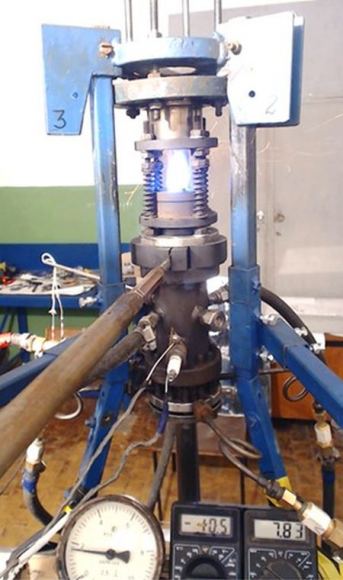
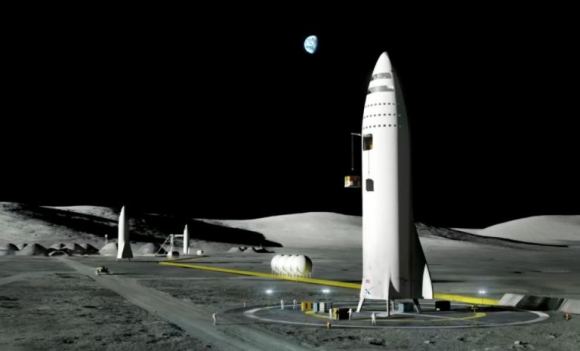
Engineers Propose a Rocket that Consumes Itself as it Flies to Space When it comes to the new era of space exploration, one of the primary focuses has been on cutting costs. By reducing the costs associated with individual launches, space agencies and private aerospace companies will not only be able to commercialize Low Earth-Orbit (LEO), but also mount far more in the way of exploration missions and maybe even colonize space. Several methods have been proposed so far for reducing launch costs, which include reusable rockets and single-stage-to-orbit rockets. However, a team of engineers from the University of Glasgow and the Ukraine recently proposedRead More →

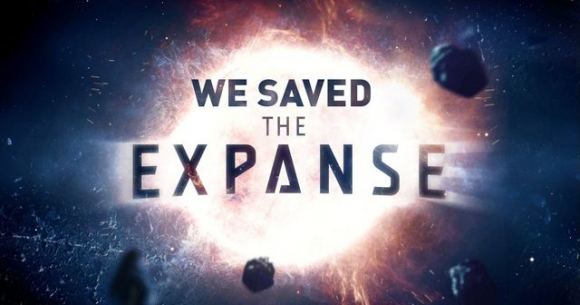
Clearly a Fan. Jeff Bezos Himself Announced that Amazon was Picking up The Expanse At Comic-Con 2015, fans of space opera and science fiction were treated to their first glimpse of The Expanse, the miniseries adaptation of Daniel Abraham and Ty Franck’s novels. Needless to say, the reaction was magnificent, and is perhaps best up by IO9’s Lauren Davis, who penned a review of the trailer titled, “The Expanse Is the Show We’ve Been Wanting Since Battlestar Galactica. It was therefore a bit of a blow when recently, the Syfy network announced that the third season (which is currently airing) would be the show’s last. ReactionRead More →

Weekly Space Hangout: May 30, 2018: Skylias – Science Communicating on Twitch! Hosts: Fraser Cain (universetoday.com / @fcain) Dr. Paul M. Sutter (pmsutter.com / @PaulMattSutter) Dr. Kimberly Cartier (KimberlyCartier.org / @AstroKimCartier ) Dr. Morgan Rehnberg (MorganRehnberg.com / @MorganRehnberg & ChartYourWorld.org) Special Guests: This week, we are excited to welcome Skylias, aka “”Sky”” to the Weekly Space Hangout. Sky is a science communicator on Twitch.tv. She discovered her passion for live streaming science, mainly astronomy/physics on Twitch.tv, while working towards her own science degree. Sky graduated magna cum laude from Regis University with a B.S. in Computer Science. While not in front of the camera orRead More →

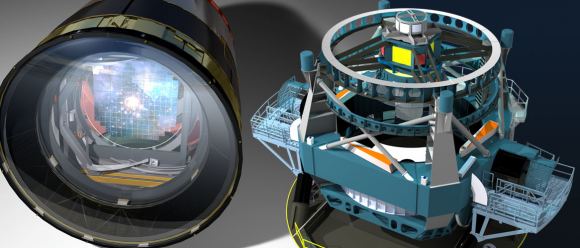
What are the Chances that the Next Generation LSST Could Find New Planets in the Solar System? In the past few decades, thanks to improvements in ground-based and space-based observatories, astronomers have discovered thousands of planets orbiting neighboring and distant stars (aka. extrasolar planets). Strangely enough, it is these same improvements, and during the same time period, that enabled the discovery of more astronomical bodies within the Solar System. These include the “minor planets” of Eris, Sedna, Haumea, Makemake, and others, but also the hypothesized planetary-mass objects collectively known as Planet 9 (or Planet X). In a new study led by the Lowell Observatory, aRead More →

This is What Happens When a Black Hole Gobbles up a Star At the center of our galaxy resides a Supermassive Black Hole (SMBH) known as Sagittarius A. Based on ongoing observations, astronomers have determined that this SMBH measures 44 million km (27.34 million mi) in diameter and has an estimated mass of 4.31 million Solar Masses. On occasion, a star will wander too close to Sag A and be torn apart in a violent process known as a tidal disruption event (TDE). These events cause the release of bright flares of radiation, which let astronomers know that a star has been consumed. Unfortunately, forRead More →

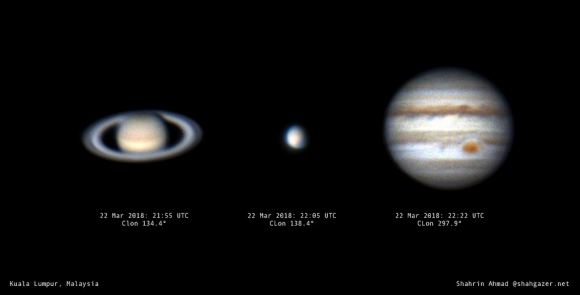
Planets on Parade: Saturn at Opposition 2018 Saturn, Mars and Jupiter all beckon this summer. Image credit and copyright: Sharin Ahmad (@shahgazer). We’re in the midst of a parade of planets crossing the evening sky. Jupiter reached opposition on May 9th, and sits high to the east at dusk. Mars heads towards a fine opposition on July 27th, nearly as favorable as the historic opposition of 2003. And Venus rules the dusk sky in the west after the setting Sun for most of 2018. June is Saturn’s turn, as the planet reaches opposition this year on June 27th, rising opposite to the setting Sun atRead More →

Carnival of Space #563 It’s that time again! This week’s Carnival of Space is hosted by Pamela Hoffman at the Everyday Spacer blog. Click here to read Carnival of Space #563. And if you’re interested in looking back, here’s an archive to all the past Carnivals of Space. If you’ve got a space-related blog, you should really join the carnival. Just email an entry to susie@wshcrew.space, and the next host will link to it. It will help get awareness out there about your writing, help you meet others in the space community – and community is what blogging is all about. And if you really want toRead More →

Virgin Galactic Performs the Second Test of VSS Unity, Reaching Mach 1.9 When it comes to the dream of commercial space exploration and space tourism, a few names really stand out. In addition to Elon Musk and Jeff Bezos, you have Richard Branson – the founder and CEO of the Virgin Group. For years, Branson has sought to make space tourism a reality through Virgin Galactic, which would take passengers into suborbit using his SpaceShipTwo class of rocket planes. Unfortunately, Virgin Galactic suffered a number of setbacks in recent years, at the same time that competitors like SpaceX and Blue Origin emerged as competitors. However,Read More →

Here’s What Really Happened to That Camera That Melted During a Rocket Launch NASA photographers have always understood that taking pictures of space launches is a risky business. No one is more familiar with this than Bill Ingalls, a NASA photographer who has taking pictures for the agency for the past 30 years. Both within the agency and without, his creativity and efforts are well known, as his ability to always know exactly where to set up his cameras to get the perfect shots. Which naturally begs the question, what happened to the camera featured in the image above? This photograph, which shows one ofRead More →

Astronomers Observe a Pulsar 6500 Light-Years From Earth and See Two Separate Flares Coming off its Surface Astronomy can be a tricky business, owing to the sheer distances involved. Luckily, astronomers have developed a number of tools and strategies over the years that help them to study distant objects in greater detail. In addition to ground-based and space-based telescopes, there’s also the technique known as gravitational lensing, where the gravity of an intervening object is used to magnify light coming from a more distant object. Recently, a team of Canadian astronomers used this technique to observe an eclipsing binary millisecond pulsar located about 6500 lightRead More →

Pluto is What You Get When a Billion Comets Smash Together Pluto has been the focus of a lot of attention for more than a decade now. This began shortly after the discovery of Eris in the Kuiper Belt, one of many Kuiper Belt Objects (KBOs) that led to the “Great Planetary Debate” and the 2006 IAU Resolution. Interest in Pluto also increased considerably thanks to the New Horizons mission, which conducted the first flyby of this “dwarf planet” in July of 2015. The data this mission provided on Pluto is still proving to be a treasure trove for astronomers, allowing for new discoveries aboutRead More →