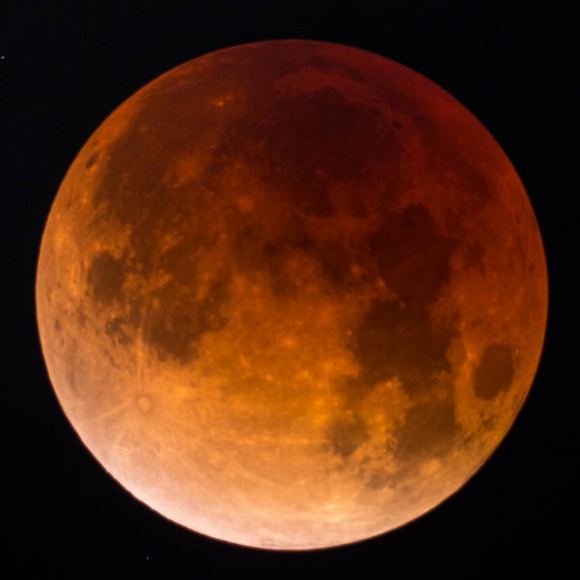
Here Are Some Amazing Pictures of the January 2018 Lunar Eclipse On Wednesday, January 31st (i.e. today!), a spectacular celestial event occurred. For those who live in the western part of North America, Alaska, and the Hawaiian islands, it was visible in the wee hours of the morning – and some people were disciplined enough to roll out of bed to see it! This was none other than the highly-anticipated “Super Blue Moon“, a rare type of full moon that on this occasion was special for a number of reasons. For one, it was the third in a series of “supermoons”, where a Full MoonRead More →
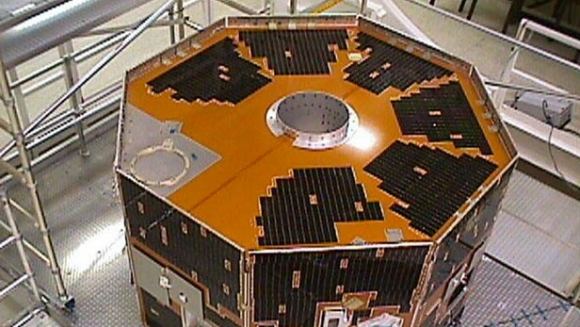
Now That NASA’s Missing IMAGE Satellite Has Been Found, Talking To It Is Going To Be Difficult It’s easy to imagine the excitement NASA personnel must have felt when an amateur astronomer contacted NASA to tell them that he might have found their missing IMAGE satellite. After all, the satellite had been missing for 10 years. IMAGE, which stands for Imager for Magnetopause-to-Aurora Global Exploration, was launched on March 25th, 2000. In Dec. 2005 the satellite failed to make routine contact, and in 2007 it failed to reboot. After that, the mission was declared over. NASA’s IMAGE satellite. Credit: NASA It’s astonishing that after 10Read More →

Weekly Space Hangout – Jan 31, 2018: Andrzej Stewart of the Hi-SEAS IV Mars Simulation Mission Hosts: Fraser Cain (universetoday.com / @fcain) Dr. Paul M. Sutter (pmsutter.com / @PaulMattSutter) Dr. Kimberly Cartier (KimberlyCartier.org / @AstroKimCartier ) Dr. Morgan Rehnberg (MorganRehnberg.com / @MorganRehnberg & ChartYourWorld.org) Special Guest: Andrzej Stewart currently works in Mission Control at the Johnson Space Center in Houston, Texas. However, from 2015-2016, Andrzej acted as the Chief Engineering Officer during the year-long Hawaii Space Exploration Analog and Simulation (Hi-SEAS) IV Mars simulation mission on Mauna Loa. Prior to that he participated in NASA’s Human Exploration Research Analog (HERA) simulation where he acted asRead More →

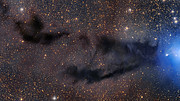
Glory From Gloom A dark cloud of cosmic dust snakes across this spectacular wide field image, illuminated by the brilliant light of new stars. This dense cloud is a star-forming region called Lupus 3, where dazzlingly hot stars are born from collapsing masses of gas and dust. This image was created from images taken using the VLT Survey Telescope and the MPG/ESO 2.2-metre telescope and is the most detailed image taken so far of this region. ESO News Feed Go to Source Powered by WPeMaticoRead More →

Microbes May Help Astronauts Turn Human Waste Into Food Geoscience researchers at Penn State University are finally figuring out what organic farmers have always known: digestive waste can help produce food. But whereas farmers here on Earth can let microbes in the soil turn waste into fertilizer, which can then be used to grow food crops, the Penn State researchers have to take a different route. They are trying to figure out how to let microbes turn waste directly into food. There are many difficulties with long-duration space missions, or with lengthy missions to other worlds like Mars. One of the most challenging difficulties isRead More →

Watch this Chilling Animation of Capetown’s Water Disappearing For almost two decades, NASA’s Earth Observatory has provided a constant stream of information about the Earth’s climate, water cycle, and meteorological patterns. This information has allowed scientists to track weather systems, map urban development and agriculture, and monitor for changes in the atmosphere. This has been especially important given the impact of Anthropogenic Climate Change. Theewaterskloof Dam—the largest reservoir and the source of roughly half of the city’s water Consider the images recently released by the Earth Observatory, which show how the city of Cape Town, South Africa has been steadily depleting its supply of freshRead More →

Carnival of Space #546 This week’s Carnival of Space is hosted by Allen Versfeld at his Urban Astronomer blog. Click here to read Carnival of Space #546. And if you’re interested in looking back, here’s an archive to all the past Carnivals of Space. If you’ve got a space-related blog, you should really join the carnival. Just email an entry to susie@wshcrew.space, and the next host will link to it. It will help get awareness out there about your writing, help you meet others in the space community – and community is what blogging is all about. And if you really want to help out, sign upRead More →

What’ll It Take to Find Life? Searching the Universe for Biosignatures The supertelescopes are coming, enormous ground and space-based observatories that’ll let us directly observe the atmospheres of distant worlds. We know there’s life on Earth, and our atmosphere tells the tale, so can we do the same thing with extrasolar planets? It turns out, coming up with a single biosignature, a chemical in the atmosphere that tells you that yes, absolutely, there’s life on that world, is really tough. I’ve got to admit, I’ve been pretty bad for this in the past. In old episodes of Astronomy Cast and the Weekly Space Hangout, evenRead More →

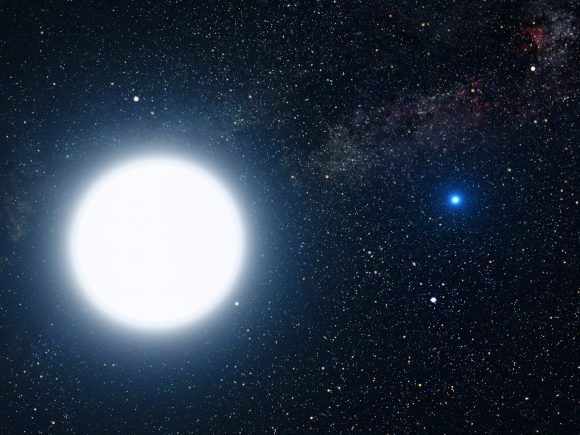
The Brightest Star in the Sky, Sirius, was Hiding a Cluster of Stars. Found by Gaia In December of 2013, the European Space Agency’s Gaia mission took to space. Since that time, this space observatory has been studying a billion astronomical objects – including stars, planets, comets, asteroids and galaxies – for the sake of creating the most precise 3D space catalog ever made. By the time the mission wraps up (later this year, barring extensions), it is expected to reveal some truly amazing things about our Universe. In fact, with the first release of its data, the Gaia probe revealed something that has goneRead More →

The existence of large numbers of molecules in winds powered by supermassive black holes at the centers of galaxies has puzzled astronomers since they were discovered more than a decade ago. Molecules trace the coldest parts of space, and black holes are the most energetic phenomena in the universe, so finding molecules in black hole winds was like discovering ice in a furnace. Powered by WPeMaticoRead More →

Using the Atacama Large Millimeter Array (ALMA) in Chile, a team of researchers has detected the emission of deuterated formaldehyde (HDCO) from the hot inner region of the protostar HH 212. The finding, reported January 20 in a paper published on the arXiv.org pre-print repository, could be helpful in our understanding of chemical processes in this protostar and in similar objects. Powered by WPeMaticoRead More →

If you gazed at the night sky over the past few weeks, it is possible that you stumbled upon a very bright star near the Orion constellation. This is Sirius, the brightest star of the entire night sky, which is visible from almost everywhere on Earth except the northernmost regions. It is, in fact, a binary stellar system, and one of the nearest to our Sun – only eight light-years away. Powered by WPeMaticoRead More →

A team of scientists, led by Boy Lankhaar at Chalmers University of Technology, has solved an important puzzle in astrochemistry—how to measure magnetic fields in space using methanol, the simplest form of alcohol. Their results, published in the journal Nature Astronomy, give astronomers a new way of investigating how massive stars are born. Powered by WPeMaticoRead More →

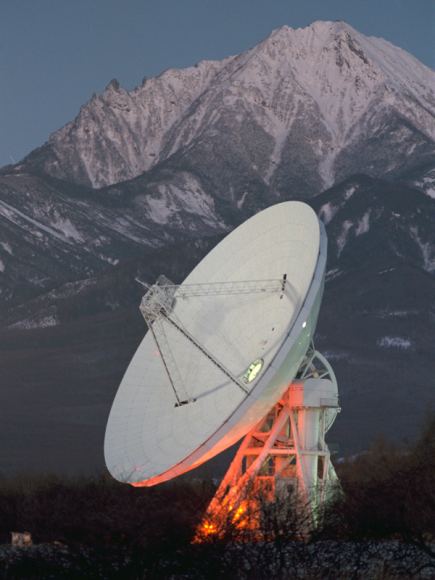
The Most Detailed Map Ever Made of the Milky Way in Radio Waves A Japanese telescope has produced our most detailed radio wave image yet of the Milky Way galaxy. Over a 3-year time period, the Nobeyama 45 meter telescope observed the Milky Way for 1100 hours to produce the map. The image is part of a project called FUGIN (FOREST Unbiased Galactic plane Imaging survey with the Nobeyama 45-m telescope.) The multi-institutional research group behind FUGIN explained the project in the Publications of the Astronomical Society of Japan and at arXiv. The Nobeyama 45 meter telescope is located at the Nobeyama Radio Observatory, nearRead More →

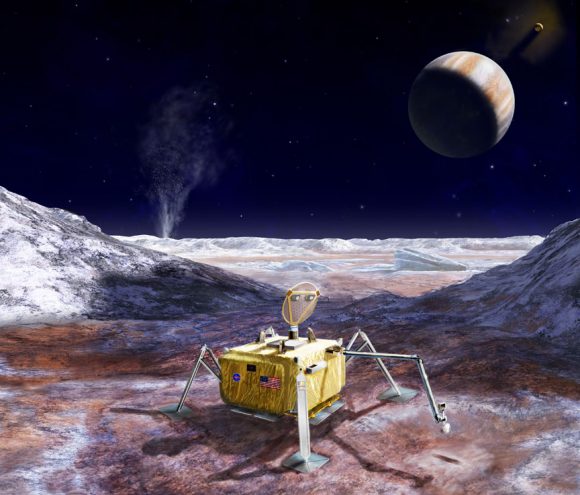
Icy Worlds Like Europa and Enceladus Might Actually be too Soft to Land On Some truly interesting and ambitious missions have been proposed by NASA and other space agencies for the coming decades. Of these, perhaps the most ambitious include missions to explore the “Ocean Worlds” of the Solar System. Within these bodies, which include Jupiter’s moon Europa and Saturn’s moon Enceladus, scientists have theorized that life could exist in warm-water interior oceans. By the 2020s and 2030s, robotic missions are expected to reach these worlds and set down on them, sampling ice and exploring their plumes for signs of biomarkers. But according to aRead More →