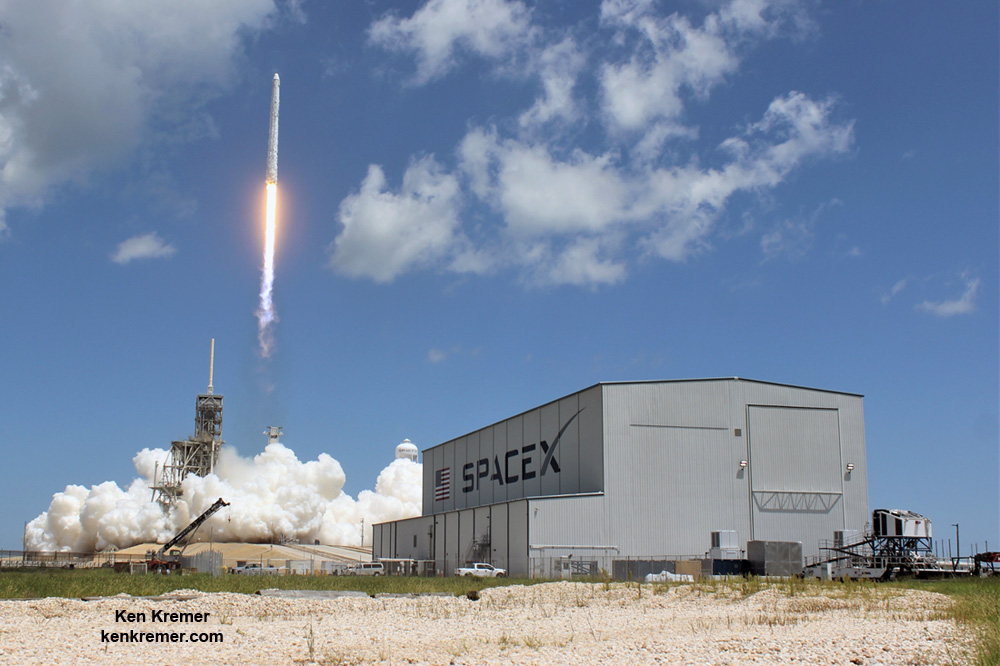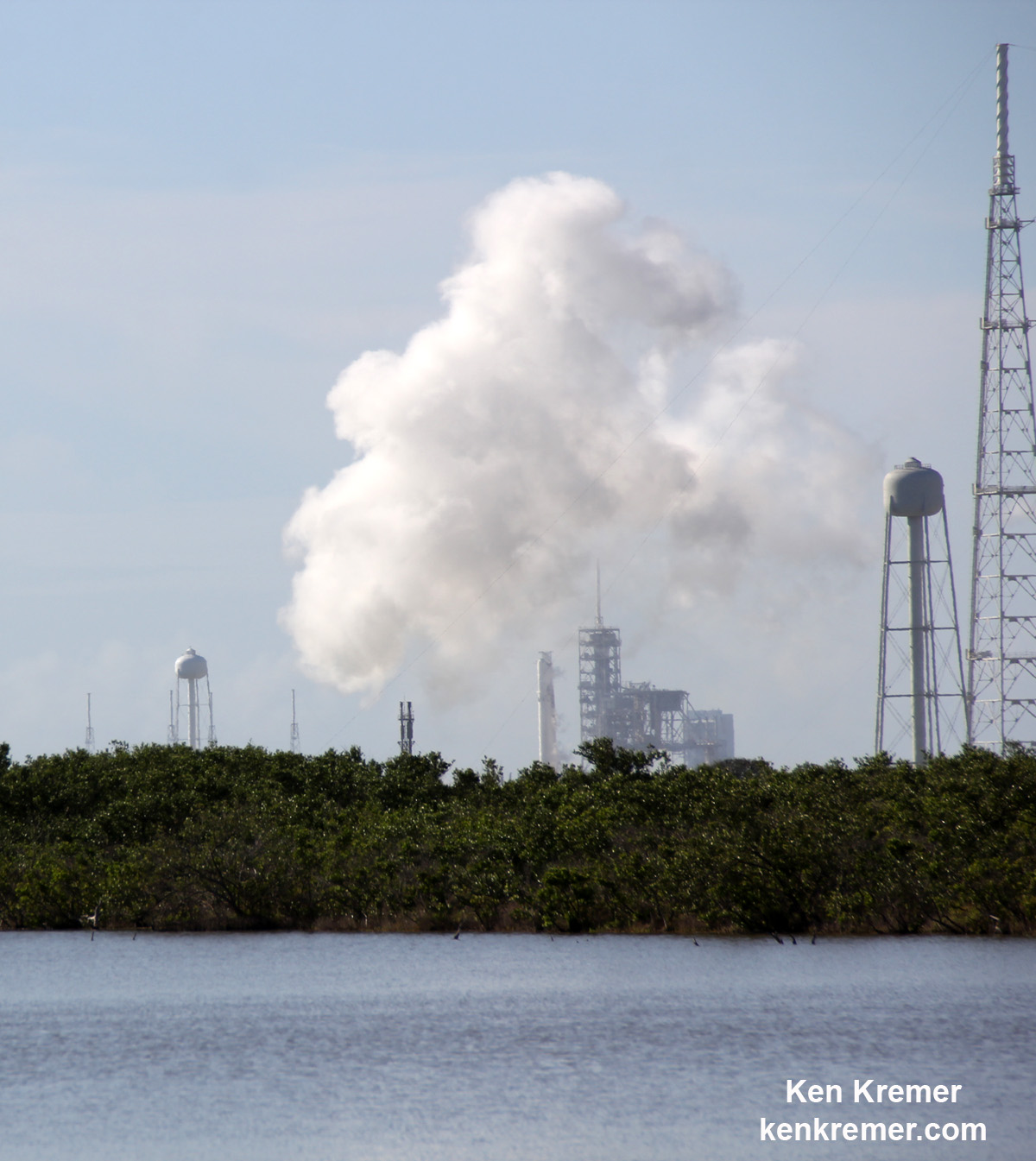
High Winds Scrub Legless Falcon 9 Liftoff Reset to March 16 – Live Webcast The countdown clock at NASA’s Kennedy Space Center shows the progress of the SpaceX Falcon launch attempt with the EchoStar 23 telecomsat from historic Launch Complex 39A after midnight March 14. Liftoff has been rescheduled for March 16 at 1:35 a.m. EDT. Credit: Ken Kremer/Kenkremer.com KENNEDY SPACE CENTER, FL – High winds halted SpaceX’s early morning attempt to launch a legless Falcon 9 rocket and the EchoStar XXIII commercial communications satellite soon after midnight Tuesday, Mar. 14, from the Florida Space Coast amidst on and off rain showers and heavy cloudRead More →

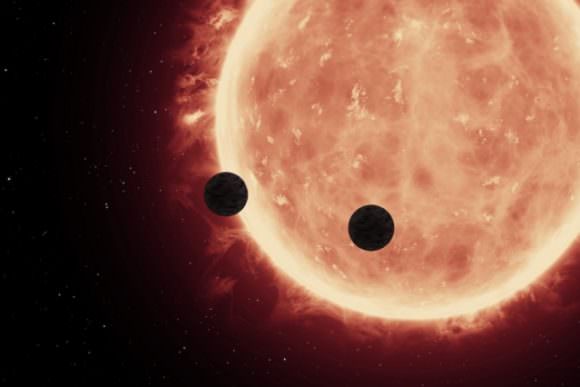
NASA Brings Trappist-1 Into Focus… Kinda Sorta On February 22nd, 2017, NASA announced the discovery of a seven-planet system around the red dwarf star known as TRAPPIST-1. Since that time, a number of interesting revelations have been made. For starters, the Search for Extra-Terrestrial Intelligence (SETI) recently announced that it was already monitoring this system for signs of advanced life (sadly, the results were not encouraging). In their latest news release about this nearby star system, NASA announced the release of the first images taken of this system by the Kepler mission. As humanity’s premier planet-hunting mission, Kepler has been observing this system since DecemberRead More →

Warm Poles Suggest Enceladus’ Liquid Water Near Surface One of the biggest surprises from the Cassini mission to Saturn has been the discovery of active geysers at the south pole of the moon Enceladus. At only about 500 km (310 miles) in diameter, the bright and ice-covered moon should be too small and too far from the Sun to be active. Instead, this little moon is one of the most geothermally active places in the Solar System. Now, a new study from Cassini data shows that the south polar region of Enceladus is even warmer than expected just a few feet below its icy surface.Read More →

Canada To Get Its Own Spaceport Canada is getting its own rocket-launching facility. Maritime Launch Services (MLS) has confirmed its plans to build and operate a commercial launch facility in Nova Scotia, on Canada’s east coast. The new spaceport should begin construction in 1 year, and should be in operation by 2022. The facility will be built near Canso, in the province of Nova Scotia. Maritime Launch Services hopes to launch 8 rockets per year to place satellites in orbit. The Ukrainian Cyclone 4M medium-class rockets that will lift-off from Canso will have a payload of up to 3,350 kg. The red marker in theRead More →

Trump’s NASA Authorization Act In All Its Glory It’s no secret that NASA has had its share of worries with the Trump administration. In addition to being forced to wait several months to get a sense of the administration’s priorities, the space agency has also had to contend with proposed cuts to its Earth Observation and climate monitoring programs. But one thing which does not appear to be threatened is NASA’s “Journey to Mars“. In accordance with the National Aeronautics and Space Administration Transition Authorization Act of 2017, the Trump administration has finally committed to funding NASA’s plans for deep space human exploration in theRead More →

What’s on the Surface of Venus? We’re always talking about Mars here on the Guide to Space. And with good reason. Mars is awesome, and there’s a fleet of spacecraft orbiting, probing and crawling around the surface of Mars. The Red Planet is the focus of so much of our attention because it’s reasonably close and offers humanity a viable place for a second home. Well, not exactly viable, but with the right technology and techniques, we might be able to make a sustainable civilization there. We have the surface of Mars mapped in great detail, and we know what it looks like from theRead More →

Are You Ready For The NanoSWARM? We’re accustomed to the ‘large craft’ approach to exploring our Solar System. Probes like the Voyagers, the Mariners, and the Pioneers have written their place in the history of space exploration. Missions like Cassini and Juno are carrying on that work. But advances in technology mean that Nanosats and Cubesats might write the next chapter in the exploration of our Solar System. Nanosats and Cubesats are different than the probes of the past. They’re much smaller and cheaper, and they offer some flexibility in our approach to exploring the Solar System. A Nanosat is defined as a satellite withRead More →

Exploring the Universe For Magnetic Fields In the past few decades, astronomers and geophysicists have benefited immensely from the study of planetary magnetic fields. Dedicated to mapping patterns of magnetism on other astronomical bodies, this field has grown thanks to missions ranging from the Voyager probes to the more recent Mars Atmosphere and Volatile EvolutioN (MAVEN) mission. Looking ahead, it is clear that this field of study will play a vital role in the exploration of the Solar System and beyond. As Jared Espley of NASA’s Goddard Space Flight Center outlined during a presentation at NASA’s Planetary Science Vision 2050 Workshop, these goals include advancingRead More →

March Launch Madness: Triple Headed Space Spectacular Starts Overnight with SpaceX March 14 – Watch Live SpaceX Falcon 9 rocket carrying EchoStar 23 telecomsat raised erect atop Launch Complex 39A at the Kennedy Space Center as seen from inside the pad on March 13, 2017 ahead of liftoff slated for 14 Mar 2017 at 1:34 a.m. Credit: Ken Kremer/Kenkremer.com Indeed a trio of launches is planned in the next week as launch competitor and arch rival United Launch Alliance (ULA) plans a duo of nighttime blastoffs from their Delta and Atlas rocket families – following closely on the heels of the SpaceX Falcon 9 launchingRead More →

Strange Loner Planet Gets Astronomers’ Attention In the hunt for exoplanets, some rather strange discoveries have been made. Beyond our Solar System, astronomers have spotted gas giants and terrestrial planets that appear to be many orders of magnitude larger than what we are used to (aka. “Super-Jupiters” and “Super-Earths”). And in some cases, it has not been entirely clear what our instruments have been detecting. For instance, in some cases, astronomers have not been if an exoplanet candidate was a super-Jupiter or a brown dwarf. Not only do these substellar-mass stars fall into the same temperature range as massive gas giants, they also share manyRead More →

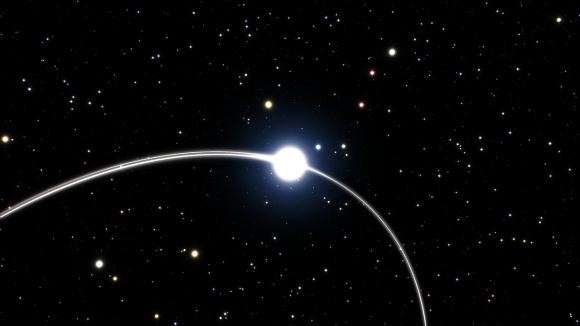
Closest Star Around A Black Hole Discovered Imagine being caught in the clutches of a black hole, being whirled around at dizzying speeds and having your mass slowly but continually sucked away. That’s the life of a white dwarf star that is doing an orbital dance with a black hole. And this dancing duo could be the first ultracompact black hole X-ray binary identified in our galaxy. “This white dwarf is so close to the black hole that material is being pulled away from the star and dumped onto a disk of matter around the black hole before falling in,” said Arash Bahramian from theRead More →

Messier 37 – the NGC 2099 Open Star Cluster Welcome back to Messier Monday! In our ongoing tribute to the great Tammy Plotner, we take a look at the Pinweel Cluster, otherwise known as Messier 36. Enjoy! During the 18th century, famed French astronomer Charles Messier noted the presence of several “nebulous objects” in the night sky. Having originally mistaken them for comets, he began compiling a list of them so that others would not make the same mistake he did. In time, this list (known as the Messier Catalog) would come to include 100 of the most fabulous objects in the night sky. OneRead More →

Carnival of Space #500 This week’s Carnival of Space is hosted by Stefan Lamoureux at the Links Through Space blog. Click here to read Carnival of Space #500. And if you’re interested in looking back, here’s an archive to all the past Carnivals of Space. If you’ve got a space-related blog, you should really join the carnival. Just email an entry to carnivalofspace@gmail.com, and the next host will link to it. It will help get awareness out there about your writing, help you meet others in the space community – and community is what blogging is all about. And if you really want to helpRead More →

Next Cygnus Cargo Ship Christened the SS John Glenn to Honor First American in Orbit The Orbital ATK Cygnus spacecraft named for Sen. John Glenn, one of NASA’s original seven astronauts, stands inside the Payload Hazardous Servicing Facility at NASA’s Kennedy Space Center in Florida behind a sign commemorating Glenn. Credit: Ken Kremer/Kenkremer.com KENNEDY SPACE CENTER, FL – The next Cygnus cargo ship launching to the International Space Station (ISS) has been christened the ‘S.S. John Glenn’ to honor legendary NASA astronaut John Glenn – the first American to orbit the Earth back in February 1962. John Glenn was selected as one of NASA’s originalRead More →

Exploring Titan with Aerial Platforms Last week, from Monday Feb. 27th to Wednesday March 1st, NASA hosted the “Planetary Science Vision 2050 Workshop” at their headquarters in Washington, DC. During the course of the many presentations, speeches and addresses that made up the workshop, NASA and its affiliates shared their many proposals for the future of Solar System exploration. A very popular theme during the workshop was the exploration of Titan. In addition to being the only other body in the Solar System with a nitrogen-rich atmosphere and visible liquid on its surface, it also has an environment rich in organic chemistry. For this reason,Read More →

Fried Egg? Flying Saucer? Nope. Just Cool New Closeups of Saturn’s Moon Pan This new view of Saturn’s moon Pan is the closest yet, snapped by Cassini from a distance of 15,268 miles (24,572 km) on March 7, 2017. Pan measures 22 miles wide by 14 miles across and displays a number of small craters along with parallel ridges and grooves in addition to its relatively smooth equatorial “flap.” Credit: NASA/JPL/Space Science Institute Besides Earth, Saturn may be the only other planet where you can order rings with a side of ravioli. Closeup photos taken by the Cassini probe of the the planet’s second-innermost moon, Pan,Read More →

Earth’s Twisted Sister: How Will We Reveal Venus’ Secrets? Venus is known as Earth’s Sister Planet. It’s roughly the same size and mass as Earth, it’s our closest planetary neighbor, and Venus and Earth grew up together. When you grow up with something, and it’s always been there, you kind of take it for granted. As a species, we occasionally glance over at Venus and go “Huh. Look at Venus.” Mars, exotic exoplanets in distant solar systems, and the strange gas giants and their moons in our own Solar System attract much more of our attention. If a distant civilization searched our Solar System forRead More →

Astronomy Cast Ep. 443: Destroy and Rebuild Pt. 7: Tsunamis Surf’s up! Today we’re going to be talking about one of the most devastating natural disasters out there: tsunamis. We’re talking huge waves that wreck the seashore. But it turns out, there many ways you can get a tsunami, and one of those has to do with space. Visit the Astronomy Cast Page to subscribe to the audio podcast! We usually record Astronomy Cast as a live Google+ Hangout on Air every Friday at 1:30 pm Pacific / 4:30 pm Eastern. You can watch here on Universe Today or from the Astronomy Cast Google+ page.Read More →

Weekly Space Hangout – Mar 10, 2017: Nic DiPalma and Spacetime Labs Host: Fraser Cain (@fcain) Special Guest: Nic DiPalma is the Founder and CEO of SpacetimeLabs, a ‘creative agency’ for science – a team of award-winning designers, producers, and developers creating brands, communication strategies, and digital content for the science community. With 20 years’ experience as a creative director, designer, and entrepreneur in educational media, public television, broadcast/cable news, corporate brand strategy, and experience design for web and mobile products, Nic is helping scientists and researchers engage the public to inspire a deeper connection and greater support. Guests: Kimberly Cartier ( KimberlyCartier.org / @AstroKimCartierRead More →

Comet Encke Reemerges in the Dawn Sky Comet 2P Encke glides through Pisces on February 16th. Image credit and copyright: Hisayoshi Kato. Miss out on Comet 45/P Honda-Mrkos-Padadušáková last month? We’ll admit, it was fairly underwhelming in binoculars… but fear not, there are several other binocular comets in the pipeline for 2017. Maybe you managed to catch sight of periodic Comet 2P Encke in late February after sunset before it disappeared into the Sun’s glare. Pronounced (En-Key), the comet actually passes through the field of view of the joint NASA/ESA Solar Heliospheric Observatory’s (SOHO) LASCO C3 camera from March 8th to March 14th before reemergingRead More →