It Might Be Possible to Refreeze the Icecaps to Slow Global Warming One of the most worrisome aspects of Climate Change is the role played by positive feedback mechanisms. In addition to global temperatures rising because of increased carbon dioxide and greenhouse gas emissions, there is the added push created by deforestation, ocean acidification, and (most notably) the disappearance of the Arctic Polar Ice Cap. However, according to a new study by a team of researchers from the School of Earth and Space Exploration at Arizona State University, it might be possible to refreeze parts of the Arctic ice sheet. Through a geoengineering technique thatRead More →

NASA Fires a Rocket into the Northern Lights, for Science! Not only is it aurora season in Alaska, its sounding rocket season! NASA started launching a series of five sounding rockets from the Poker Flat Research Range in Alaska to study the aurora. The first of these rockets for this year, a Black Brant IX, was launched in the early morning hours of February 22, 2017. The instrument on board was an Ionospheric Structuring: In Situ and Groundbased Low Altitude StudieS (ISINGLASS) instrumented payload, which studies the structure of an aurora. The Black Brant IX sounding rocket carried instruments to an altitude of 225 milesRead More →

Ring of Fire: Catch the Only Annular Solar Eclipse of 2017 This Sunday The May 2012 annular solar eclipse. Image credit and copyright: Kevin Baird. ‘Tis the season… eclipse season that is, as a spectacular “ring of fire” annular solar eclipse marks the end of the first of two eclipse cycles for 2017. And although the annular path for this eclipse passes through some sparsely populated parts of the southern hemisphere, we just might get some amazing live views, courtesy of modern technology and some intrepid observers willing to adventurously trek after the shadow of the Moon. Unlike many of the uncertainties in life, eclipses areRead More →

SpaceX Dragon Arrives at Space Station with Tons of Earth and Human Science Experiments SpaceX CRS-10 Dragon supply ship launched on Feb. 19, 2017 from NASA’s Kennedy Space Center in Florida successfully arrives at the International Space Station on Feb. 23, 2017 for capture and berthing at station port on the Harmony module. Credit: NASA KENNEDY SPACE CENTER, FL – A SpaceX Dragon supply ship jam packed with more than 2.5 tons of critical science gear, crew supplies and 40 mice successfully arrived this morning at the International Space Station (ISS) – where six humans from the US, Russia and France are living and workingRead More →

Planet 9 Can’t Run Forever. Two Asteroids Give Up Some Clues Last year, Caltech astronomers Mike Brown and Konstantin Batygin found indirect evidence for the existence of a large planet in the outer reaches of our Solar System — likely located out past Pluto — and since then, the search has been on. The latest research continues to show signs of an unseen planet, the hypothetical Planet 9. Astronomers using the Gran Telescopio CANARIAS (GTC) in the Canary Islands looked at two distant asteroids called Extreme Trans Neptunian Objects’ (ETNOs), and spectroscopic observations show and their present-day orbits could be the result of a pastRead More →

Here’s an Aerial View of a Massive Iceberg Shearing away from Antarctica Located along the east coast of the Antarctic Peninsula is the Larsen Ice Shelf. Named after the Norwegian Captain who explored the ice front back in 1893, this ice shelf has been monitored for decades due to its close connection with rising global temperatures. Essentially, since the 1990s, the shelf has been breaking apart, causing collapses of considerable intensity. According to the British Antarctic Survey (BAS), the section of the ice sheet known as the Larsen C Ice Shelf could be experiencing a collapse of its own soon enough. Based on video footageRead More →

Get Ready for the First Pictures of a Black Hole’s Event Horizon It might sound trite to say that the Universe is full of mysteries. But it’s true. Chief among them are things like Dark Matter, Dark Energy, and of course, our old friends the Black Holes. Black Holes may be the most interesting of them all, and the effort to understand them—and observe them—is ongoing. That effort will be ramped up in April, when the Event Horizon Telescope (EHT) attempts to capture our first image of a Black Hole and its event horizon. The target of the EHT is none other than Sagittarius A,Read More →

Huge News, Seven Earth-Sized Worlds Orbiting a Red Dwarf, Three in the Habitable Zone In what is surely the biggest news since the hunt for exoplanets began, NASA announced today the discovery of a system of seven exoplanets orbiting the nearby star of TRAPPIST-1. Discovered by a team of astronomers using data from the TRAPPIST telescope in Chile and the Spitzer Space Telescope, this find is especially exciting since all of these planets are believed to be Earth-sized and terrestrial (i.e. rocky). But most exciting of all is the fact that three of these rocky exoplanets orbit within the star’s habitable zone (aka. “Goldilocks Zone”).Read More →

Ultracool Dwarf and the Seven Planets Astronomers have found a system of seven Earth-sized planets just 40 light-years away. Using ground and space telescopes, including ESO’s Very Large Telescope, the planets were all detected as they passed in front of their parent star, the ultracool dwarf star known as TRAPPIST-1. According to the paper appearing today in the journal Nature, three of the planets lie in the habitable zone and could harbour oceans of water on their surfaces, increasing the possibility that the star system could play host to life. This system has both the largest number of Earth-sized planets yet found and the largestRead More →

Here’s Something We Never Thought We’d See on a Comet: Shifting Dunes The Rosetta mission’s close-up views of the curiously-shaped Comet 67P/Churyumov-Gerasimenko have already changed some long-held ideas about comets. But here’s more: there’s a ‘wind’ blowing across the comet’s surface, creating moving shifting dunes. “The approach to comet 67P/Churyumov–Gerasimenko by the spacecraft Rosetta has revealed the presence of astonishing dune-like patterns,” wrote Philippe Claudin, of the Institute of Industrial Physics and Chemistry, Paris, France, in his new paper, noting the unusual and unexpected conditions found on Comet 67P. Left, an image of comet Chury showing outgassing of water vapor, which entrains dust (© ESA/Rosetta/NAVCAM).Read More →

How Long is a Year on Venus? Venus and Earth have many similarities. Both are terrestrial planets, meaning that they are composed predominately of metal and silicate rock, which is differentiated between a metal core and a silicate mantle and crust. Both also orbit the Sun within its habitable zone (aka. “Goldilocks Zone“). Hence why Venus and Earth are often called “sister planets”. However, Venus is also starkly different from Earth in a number of ways. It’s atmosphere, which is composed primarily of carbon dioxide and small amounts of nitrogen, is 92 times as dense as Earth’s. It is also the hottest planet in theRead More →

United Arab Emirates Has a Plan to Colonize Mars with 600,000 People in 100 Years Elon Musk has been rather outspoken in recent years about his plan to create a human settlement on Mars. Stressing the need for a “backup location” for humanity, he has dedicated his company (SpaceX) to the creation of a reusable spacecraft (aka. the Interplanetary Transport System) that in the coming decades will be able to transport one-hundred people at a time to Mars. In addition to Musk, Dutch entrepreneur Bas Lansdorp has also expressed an interest in creating a permanent settlement on Mars. In 2012, he founded MarsOne with theRead More →

Spectacular SpaceX Space Station Launch and 1st Stage Landing – Photo/Video Gallery Historic maiden blastoff of SpaceX Falcon 9 rocket from Launch Complex 39A at the Kennedy Space Center) at 9:38 a.m. EDT on Feb 19, 2017, on Dragon CRS-10 resupply mission to the International Space Station (ISS) for NASA. Credit: Ken Kremer/kenkremer.com KENNEDY SPACE CENTER, FL – Sunday’s inaugural blastoff of a commercial SpaceX Falcon 9 rocket from historic pad 39A at NASA’s Kennedy Space Center on Feb. 19 proved to be space spectacular like none other along the Florida Space Coast, that will help path the path for eventual human journeys to theRead More →

Sad About Pluto? How about 110 Planets in the Solar System Instead? In 2006, during their 26th General Assembly, the International Astronomical Union (IAU) adopted a formal definition of the term “planet”. This was done in the hopes of dispelling ambiguity over which bodies should be designated as “planets”, an issue that had plagued astronomers ever since they discovering objects beyond the orbit of Neptune that were comparable in size to Pluto. Needless to say, the definition they adopted resulted in fair degree of controversy from the astronomical community. For this reason, a team of planetary scientists – which includes famed “Pluto defender” Alan SternRead More →

Drone Captures Amazing Footage of Falcon 9 Landing Let’s just take a moment to admire how amazing it is when science fiction becomes routinely real: SpaceX CEO Elon Musk shared this amazing drone footage of the Falcon 9 rocket’s first stage returning for a perfect landing after the launch of the Dragon capsule to the International Space Station. It drops flawlessly through the clouds, easy as pie, touching down at SpaceX’s Landing Zone 1 at Cape Canaveral. As cool as the first stage landing was, the launch had a notable starting place. As our Ken Kremer reported yesterday, “the era of undesired idleness for America’sRead More →

Messier 35 – the NGC 2168 Open Star Cluster Welcome back to Messier Monday! In our ongoing tribute to the great Tammy Plotner, we take a look at the open star cluster known as Messier 35. Enjoy! During the 18th century, famed French astronomer Charles Messier noted the presence of several “nebulous objects” in the night sky. Having originally mistaken them for comets, he began compiling a list of them so that others would not make the same mistake he did. In time, this list (known as the Messier Catalog) would come to include 100 of the most fabulous objects in the night sky. OneRead More →

NASA’s Historic Pad 39A Back in Business with Maiden SpaceX Falcon 9 Blastoff to ISS and Booster Landing Historic maiden blastoff of a SpaceX Falcon 9 rocket from Launch Complex 39A at the Kennedy Space Center on Dragon CRS-10 resupply mission to the International Space Station (ISS) at 9:38 a.m. EDT on Feb 19, 2017. Photo taken from the VAB roof. Credit: Ken Kremer/kenkremer.com KENNEDY SPACE CENTER, FL – After a six year lull NASA’s historic pad 39A roared back to business this morning with the dramatic maiden blastoff of a SpaceX Falcon 9 rocket, on a critical cargo delivery mission for NASA to theRead More →

Juno Will Get No Closer To Jupiter Due To Engine Troubles On July 4th, 2016, the Juno mission established orbit around Jupiter, becoming the second spacecraft in history to do so (after the Galileo probe). Since then, the probe has been in a regular 53.4-day orbit (known as perijove), moving between the poles to avoid the worst of its radiation belts. Originally, Juno’s mission scientists had been hoping to reduce its orbit to a 14-day cycle so the probe could make more passes to gather more data. To do this, Juno was scheduled for an engine burn on Oct. 19th, 2016, during its second perijovianRead More →

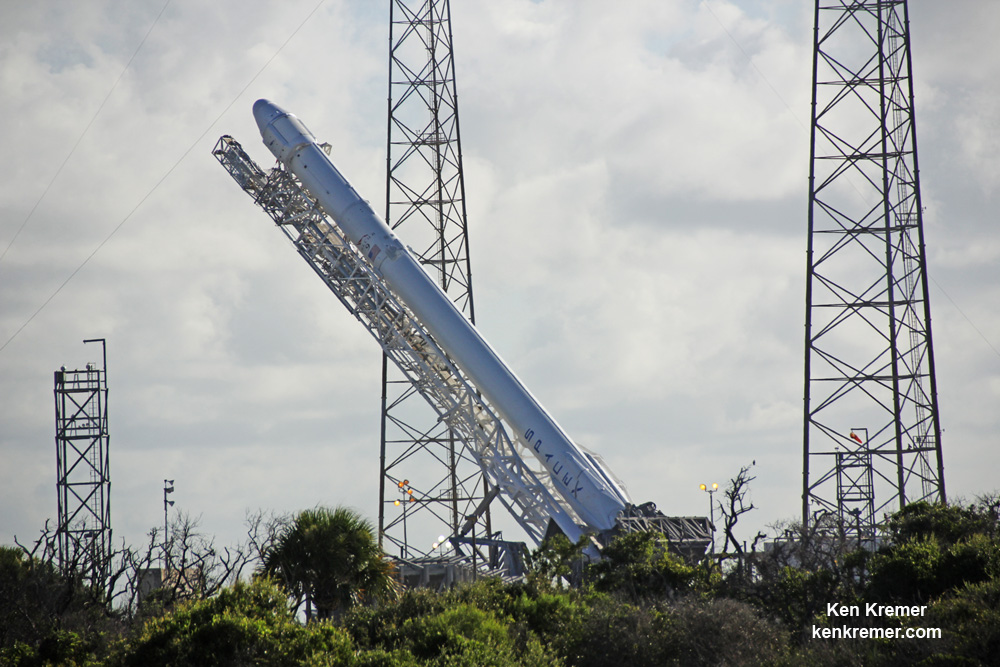
SpaceX Falcon 9 Goes Vertical with Station Science at KSC Pad 39A – Watch Live SpaceX Falcon 9 rocket goes vertical at night atop Launch Complex 39A at the Kennedy Space Center on 18 Feb 2017 as seen after midnight from the pad perimeter. This is the first rocket rolled out to launch from pad 39A since the retirement of NASA’s Space Shuttles in July 2011. Liftoff slated for 18 Feb 2017. Credit: Ken Kremer/Kenkremer.com KENNEDY SPACE CENTER, FL – Just hours before blastoff, the first ever SpaceX Falcon 9 set to soar to the space station from historic pad 39A at NASA’s Kennedy SpaceRead More →

A Region On Mars With Recent Water Is About To Get Major Attention Striations exposed on the surface between Martian sand dunes (one pictured at top) in Lucaya Crater indicate fluctuating levels of salty groundwater. At “a” we see possible cross beds which are tilted layers of sand within larger layers deposited by wind or water. At b, dark and light strata are similar to that exposed in the dune at top and resemble the striations seen in the Namib Desert on Earth. The photo was taken by NASA’s Mars Reconnaissance Orbiter in infrared, red and blue light. Credit: NASA/JPL-Caltech Researcher Dr. Mary Bourke from Trinity CollegeRead More →