The stories behind Aboriginal star names now recognised by the world’s astronomical body
2018-01-15
Four stars in the night sky have been formally recognised by their Australian Aboriginal names. Powered by WPeMaticoRead More →
Four stars in the night sky have been formally recognised by their Australian Aboriginal names. Powered by WPeMaticoRead More →
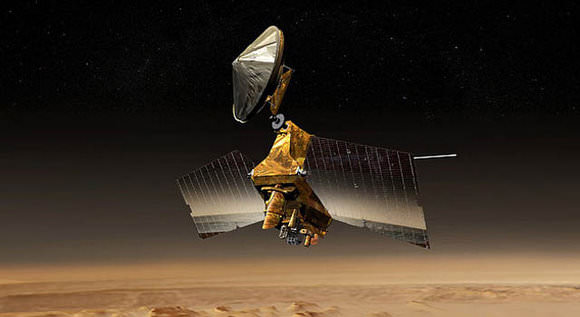
Huge Sheets of Ice Found Hidden Just Beneath the Surface of Mars Its an established fact that Mars was once a warmer and wetter place, with liquid water covering much of its surface. But between 4.2 and 3.7 billion years ago, the planet lost its atmosphere, which caused most of its surface water to disappear. Today, much of that water remains hidden beneath the surface in the form of water ice, which is largely restricted to the polar regions. In recent years, scientists have also learned of ice deposits that exist in the equatorial regions of Mars, though it was unlcear how deep they ran.Read More →
To have a full picture of the lives of massive stars, researchers need to study them in all stages – from when they’re a mass of unformed gas and dust, to their often dynamic end-of-life explosions. Powered by WPeMaticoRead More →
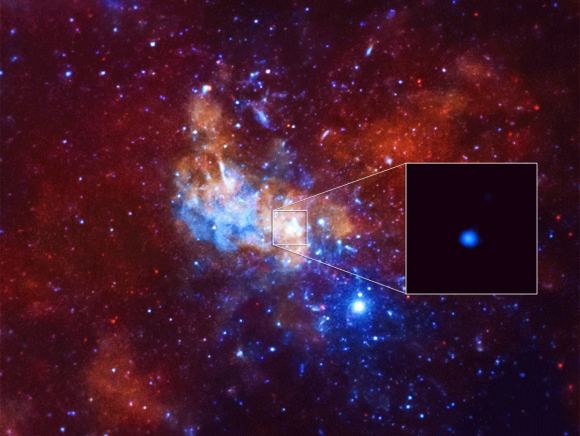
Astronomers Figure Out How Black Holes Can Blast Out Relativistic Jets of Material Across Light Years of Space Black holes have been an endless source of fascination ever since Einstein’s Theory of General Relativity predicted their existence. In the past 100 years, the study of black holes has advanced considerably, but the awe and mystery of these objects remains. For instance, scientists have noted that in some cases, black holes have massive jets of charged particles emanating from them that extend for millions of light years. These relativistic jets” – so-named because they propel charged particles at a fraction of the speed of light –Read More →
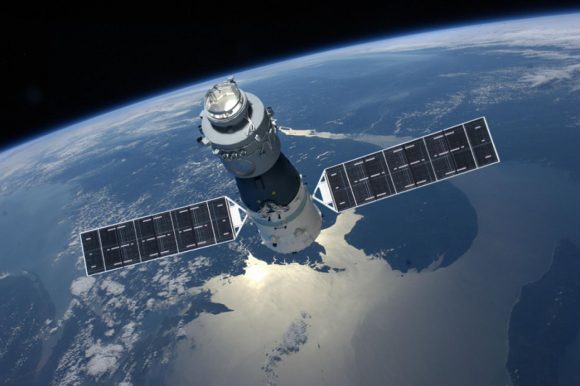
China Says it Still has Control Over Tiangong-1 and Can Decide Where It’ll Crash The Tiangong-1 space station has been the subject of a lot of interest lately. Though its mission was meant to end in 2013, the China National Space Agency extended its service until 2016. In September of 2017, after much speculation from the international community, the Agency acknowledged that the station’s orbit was degrading and that it would fall to Earth later in the year. Based on updates from satellite trackers, it has been indicated that Tianglong-1 will likely reenter our atmosphere in March of 2018, with the possibility of debris making itRead More →
An international team of scientists led by researchers from the Argelander Institute for Astronomy has mapped the mass distribution in a distant galaxy cluster (RCS2J2327). This cosmic colossus is located in the constellation Pisces at a distance of approximately 6.4 billion light years. According to current research results it consists of about 85 percent invisible dark matter. Powered by WPeMaticoRead More →
This week, Nature published an article that could challenge the theory of stellar evolution. Powered by WPeMaticoRead More →
Statistical analysis of supermassive black holes suggests that the spin of the black hole may play a role in the generation of powerful high-speed jets blasting radio waves and other radiation across the universe. Powered by WPeMaticoRead More →
Carnival of Space #543 This week’s Carnival of Space is hosted by Gadi Eidelheit at his The Venus Transit blog. Click here to read Carnival of Space #543. And if you’re interested in looking back, here’s an archive to all the past Carnivals of Space. If you’ve got a space-related blog, you should really join the carnival. Just email an entry to susie@schcrew.space, and the next host will link to it. It will help get awareness out there about your writing, help you meet others in the space community – and community is what blogging is all about. And if you really want to helpRead More →
An intensive survey deep into the universe by NASA’s Hubble and Spitzer space telescopes has yielded the proverbial needle-in-a-haystack: the farthest galaxy yet seen in an image that has been stretched and amplified by a phenomenon called gravitational lensing. Powered by WPeMaticoRead More →
For many years, astronomers had a simple view of our Milky Way’s central hub, or bulge, as a quiescent place composed of old stars, the earliest homesteaders of our galaxy. Powered by WPeMaticoRead More →
Astronomers and visualization specialists from NASA’s Universe of Learning program have combined visible and infrared vision of the Hubble and Spitzer space telescopes to create an unprecedented, three-dimensional, fly-through view of the picturesque Orion Nebula, a nearby star-forming region. Powered by WPeMaticoRead More →
A team led by CU Boulder researchers has caught a supermassive black hole in a distant galaxy snacking on gas and then “burping”—not once, but twice. Powered by WPeMaticoRead More →
In April and July 2014, the Sun emitted three jets of energetic particles into space, that were quite exceptional: the particle flows contained such high amounts of iron and helium-3, a rare variety of helium, as have been observed only few times before. Since these extraordinary events occurred on the backside of our star, they were not discovered immediately. A group of researchers headed by the Max Planck Institute for Solar System Research (MPS) and the Institute for Astrophysics of the University of Göttingen (Germany) present a comprehensive analysis now in the Astrophysical Journal. It is based on data from the twin space probes STEREORead More →
In its search for exoplanets—planets outside of our solar system—NASA’s Kepler telescope trails behind Earth, measuring the brightness of stars that may potentially host planets. The instrument identifies potential planets around other stars by looking for dips in the brightness of the stars that occur when planets cross in front of, or transit, them. Typically, computer programs flag the stars with these brightness dips, then astronomers look at each one and decide whether or not they truly could host a planet candidate. Powered by WPeMaticoRead More →
Astronomers had a mystery on their hands. No matter where they looked, from inside the Milky Way to distant galaxies, they observed a puzzling glow of infrared light. This faint cosmic light, which presents itself as a series of spikes in the infrared spectrum, had no easily identifiable source. It seemed unrelated to any recognizable cosmic feature, like giant interstellar clouds, star-forming regions, or supernova remnants. It was ubiquitous and a bit baffling. Powered by WPeMaticoRead More →
When exoplanet scientists first spotted patterns in disks of dust and gas around young stars, they thought newly formed planets might be the cause. But a recent NASA study cautions that there may be another explanation—one that doesn’t involve planets at all. Powered by WPeMaticoRead More →
Using NASA’s Hubble Space Telescope to peer deep into the vast stellar nursery called the Orion Nebula, astronomers searched for small, faint bodies. What they found was the largest population yet of brown dwarfs—objects that are more massive than planets but do not shine like stars. Researchers identified 17 brown dwarf companions to red dwarf stars, one brown dwarf pair, and one brown dwarf with a planetary companion. They also found three giant planets, including a binary system where two planets orbit each other in the absence of a parent star. This survey could only be done with Hubble’s exceptional resolution and infrared sensitivity. PoweredRead More →
Astronomers are observing star-forming regions in our galaxy with NASA’s flying telescope, the Stratospheric Observatory for Infrared Astronomy, SOFIA, to understand the processes and environments required to create the largest known stars, which tip the scales at ten times the mass of our own Sun or more. Powered by WPeMaticoRead More →

I Didn’t Realize the Scale of Their Rocket Program. China is Planning More than 40 Space Launches in 2018 It’s no secret that China’s growth in the past few decades has been reflected in space. In addition to the country’s growing economic power and international influence, it has also made some very impressive strides in terms of its space program. This includes the development of the Long March rocket family, the deployment of their first space station, and the Chinese Lunar Exploration Program (CLEP) – aka. the Chang’e program. Given all that, one would not be surprised to learn that China has some big plansRead More →

