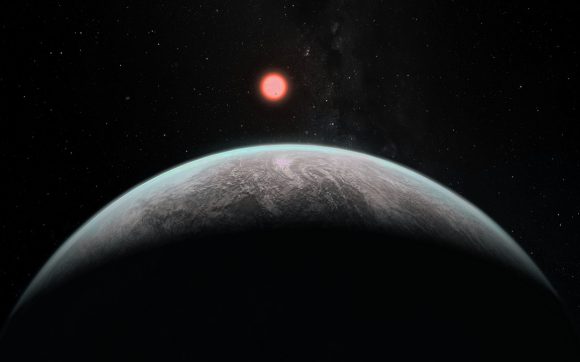
The Orbit of Earth will be Hiding Earth 2.0 In the hunt for extra-solar planets, astronomers and enthusiasts can be forgiven for being a bit optimistic. In the course of discovering thousands of rocky planets, gas giants, and other celestial bodies, is it too much to hope that we might someday find a genuine Earth-analog? Not just an “Earth-like” planet (which implies a rocky body of comparable size) but an actual Earth 2.0? This has certainly been one of the goals of exoplanet-hunters, who are searching nearby star systems for planets that are not only rocky, but orbit within their star’s habitable zone, show signsRead More →
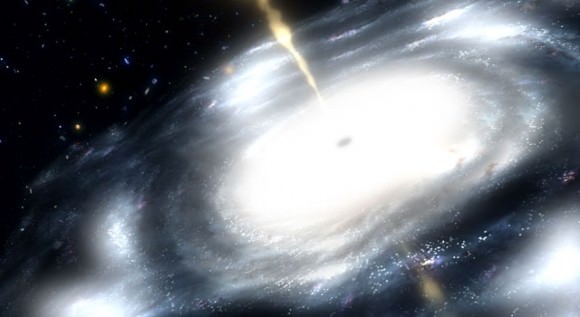
Supermassive Black Holes or Their Galaxies? Which Came First? There’s a supermassive black hole at the center of almost every galaxy in the Universe. How did they get there? What’s the relationship between these monster black holes and the galaxies that surround them? Every time astronomers look farther out in the Universe, they discover new mysteries. These mysteries require all new tools and techniques to understand. These mysteries lead to more mysteries. What I’m saying is that it’s mystery turtles all the way down. One of the most fascinating is the discovery of quasars, understanding what they are, and the unveiling of an even deeperRead More →

Now We Know When Stars Will Be Passing Through the Oort Cloud To our Solar System, “close-encounters” with other stars happen regularly – the last occurring some 70,000 years ago and the next likely to take place 240,000 to 470,000 years from now. While this might sound like a “few and far between” kind of thing, it is quite regular in cosmological terms. Understanding when these encounters will happen is also important since they are known to cause disturbances in the Oort Cloud, sending comets towards Earth. Thanks to a new study by Coryne Bailer-Jones, a researcher from the Max Planck Institute for Astronomy, astronomersRead More →

A new study using data from NASA’s Chandra X-ray Observatory and ESA’s XMM-Newton suggests X-rays emitted by a planet’s host star may provide critical clues to just how hospitable a star system could be. A team of researchers looked at 24 stars similar to the Sun, each at least one billion years old, and how their X-ray brightness changed over time. Powered by WPeMaticoRead More →

Big Solar Storm Coming Our Way, Now’s Your Chance to See Auroras An X9.3 class solar flare flashes in the middle of the Sun on Sept. 6, 2017. Credit:NASA/GSFC/SDO If you’re still riding that high from seeing the recent total solar eclipse and you want to keep the party going, now’s your chance to see another of the night sky’s wonders: an aurora. That said, a totally full Moon is going to try and wreck the party. NASA announced that two powerful flares were just emitted on the surface of the Sun, casting coronal mass ejections in our direction. Over the course of the nextRead More →

For decades, as astronomers have imagined advanced extraterrestrial civilizations, they categorized such worlds by the amount of energy their inhabitants might conceivably be able to harness and use. They sorted the hypothetical worlds into three types according to a scheme named in 1964 for Soviet astronomer Nikolai Kardashev. Powered by WPeMaticoRead More →

NASA, NOAA Satellites Track Hurricane Irma’s Path Record-setting Hurricane Irma barreled over the Caribbean islands of St. Martin, St. Barthelemy and Anguilla early Wednesday, destroying buildings and causing major flooding. The US National Hurricane Center listed the Category 5 Irma as the strongest Atlantic hurricane ever recorded north of the Caribbean and east of the Gulf of Mexico. The storm continues to roar on a path toward the U.S. Virgin Islands, Puerto Rico and possibly Florida, or along the southeast coast of the US. This animation of NOAA’s GOES East satellite imagery from Sept. 3 at 8:15 a.m. EDT (1215 UTC) to Sept. 6 endingRead More →

The discovery of the largest timing irregularity yet observed in a pulsar is the first confirmation that pulsars in binary systems exhibit the strange phenomenon known as a ‘glitch’. The study is published in the journal Monthly Notices of the Royal Astronomical Society. Powered by WPeMaticoRead More →

Another Monster Black Hole Found in the Milky Way At the center of the Milky Way Galaxy resides the Supermassive Black Hole (SMBH) known as Sagittarius A*. This tremendous black hole measures an estimated 44 million km in diameter, and has the mass of over 4 million Suns. For decades, astronomers have understood that most larger galaxies have an SMBH at their core, and that these range from hundreds of thousands to billions of Solar Masses. However, new research performed by a team of researchers from Keio University, Japan, has made a startling find. According to their study, the team found evidence of a mid-sizedRead More →

New work from a team of Carnegie scientists (and one Carnegie alumnus) asked whether any gas giant planets could potentially orbit TRAPPIST-1 at distances greater than that of the star’s seven known planets. If gas giant planets are found in this system’s outer edges, it could help scientists understand how our own Solar System’s gas giants like Jupiter and Saturn formed. Powered by WPeMaticoRead More →

Carnival of Space #525 It’s that time again! This week’s Carnival of Space is hosted by Pamela Hoffman at the Everyday Spacer blog. Click here to read Carnival of Space #525. And if you’re interested in looking back, here’s an archive to the past Carnivals of Space. If you’ve got a space-related blog, you should really join the carnival. Just email an entry to carnivalofspace@gmail.com, and the next host will link to it. It will help get awareness out there about your writing, help you meet others in the space community – and community is what blogging is all about. And if you really wantRead More →

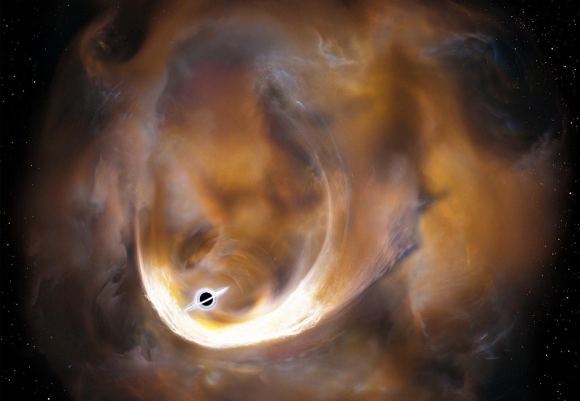
It’s easy to picture a black hole as a kind of all-powerful cosmic drain, a sinkhole of super-strong gravity that snags and swallows passing nebulae or stars. While it is true we can’t observe matter once it crosses a black hole’s event horizon, scientists are zeroing in on what happens in the margins, where molecular clouds release vast amounts of energy as it circles the plughole. Powered by WPeMaticoRead More →

(Phys.org)—A team of researchers with Keio University in Japan has found evidence of a mid-sized black hole near the center of the Milky Way galaxy. In their paper published in the journal Nature Astronomy, the group describes their study of a gas cloud cluster near the center of our galaxy and why they believe it offers evidence of a mid-sized black hole. Powered by WPeMaticoRead More →

(Phys.org)—Using the Large Binocular Telescope (LBT), a group of astronomers has found that the star-forming galaxy (SFG) J0811+4730 is the most metal-poor dwarf SFG known to date. The finding is detailed in a paper published online on Sept. 1 on the arXiv pre-print repository. Powered by WPeMaticoRead More →

(Phys.org)—A group of Chinese astronomers led by Yang Huang of the Yunnan University in Kunming, China, has detected two new unbound hypervelocity stars located over 70,000 light years away. The discovery, described in a paper published Aug. 29 on the arXiv pre-print server, could help scientists better understand the nature of these rare, peculiar stars. Powered by WPeMaticoRead More →

Gaia, ESA’s billion-star surveyor, is detecting stars and measuring their properties in order to build up the most precise 3-D map of the Milky Way. By accurately measuring the motion of each star, astronomers will be able to peer back in time to understand the Milky Way’s history, its evolution and its destiny. Powered by WPeMaticoRead More →

Researchers at DESY have compiled an extensive catalogue of variable sources of cosmic gamma radiation. For his doctoral thesis, Matteo Giomi, working at DESY in Zeuthen, analysed almost 7.5 years of observational data from NASA’s “Fermi” space telescope. Over that period, the “Large Area Telescope” (LAT) on board the satellite registered a total of 4547 bursts of gamma radiation, known as flares. Thanks to improved analytical methods, Giomi was able to assign these flares to 518 variable sources. The “Fermi All-Sky Variability Analysis” (FAVA) also lists 77 unknown sources, whose identity has not yet been determined. The “Fermi” scientists are presenting their catalogue in theRead More →