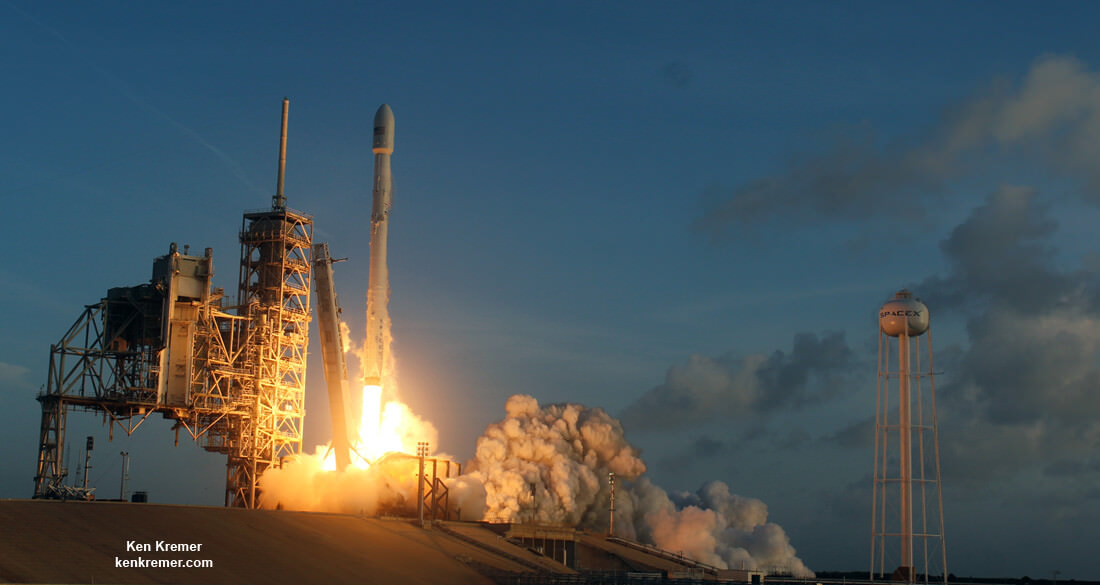
Ownerless Super Secret Zuma Spysat Set for Dark Veiled Dark Night SpaceX Blastoff and Land Landing Nov. 16: Watch Live SpaceX Falcon 9 rocket carrying classified NROL-76 surveillance satellite for the National Reconnaissance Office successfully launches shortly after sunrise from Launch Complex 39A on 1 May 2017 from NASA’s Kennedy Space Center in Florida. 1st stage accomplished successful ground landing at the Cape nine minutes later. Credit: Ken Kremer/Kenkremer.com KENNEDY SPACE CENTER, FL – The super secret ‘Zuma’ mission claimed by no U.S. government entity – not even the elusive NRO spy agency ! – and whose goals are veiled in virtually complete darkness– isRead More →

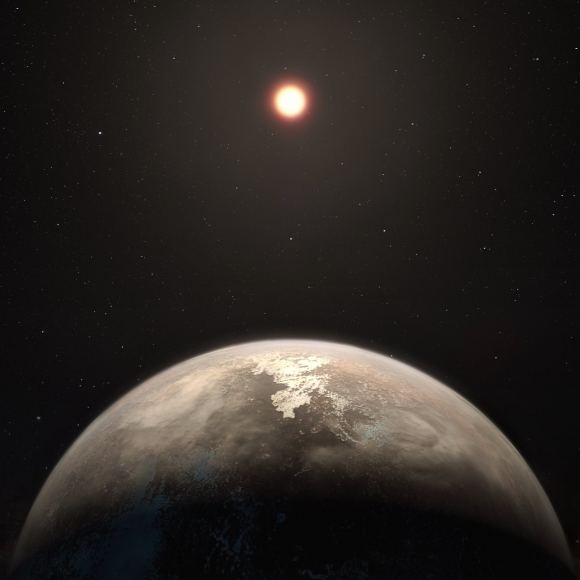
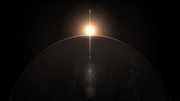
Closest Potentially-Habitable World Found Around “Quiet” Star In August of 2016, the European Southern Observatory (ESO) announced the discovery of a terrestrial (i.e. rocky) extra-solar planet orbiting within the habitable zone of the nearby Proxima Centauri star system, just 4.25 light-years away. Naturally, news of this was met with a great deal of excitement. This was followed about six months later with the announcement of a seven-planet system orbiting the nearby star of TRAPPIST-1. Well buckle up, because the ESO just announced that there is another potentially-habitable planet in our stellar neighborhood! Like Proxima b, this exoplanet – known as Ross 128b – is relativelyRead More →

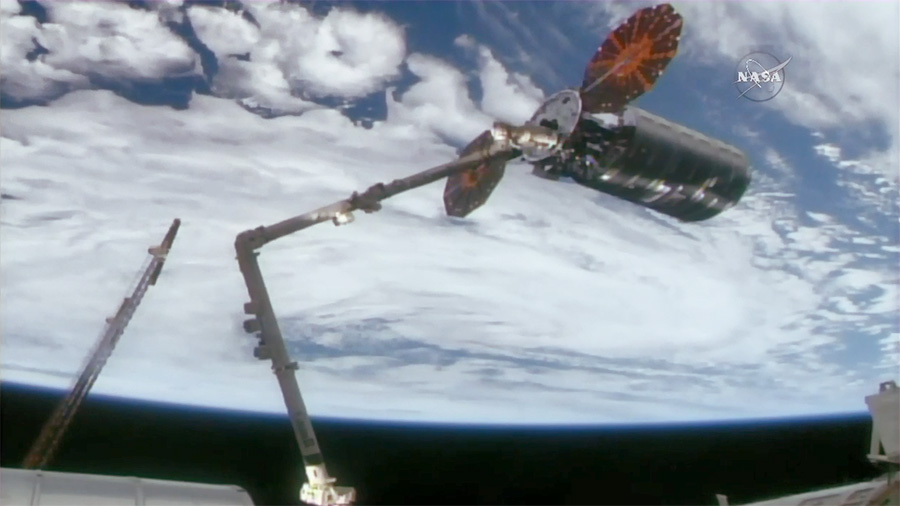
S.S Gene Cernan Honoring Last Moonwalker Arrives at International Space Station Carrying Tons of Research Gear and Supplies The Canadarm2 robotic arm is seen grappling the Orbital ATK S.S. Gene Cernan Cygnus resupply ship on Nov. 14, 2017 for berthing to the the International Space Station. Credit: NASA TV The S.S. Gene Cernan Cygnus spacecraft named in honor of the Apollo 17 lunar landing commander and launched by Orbital ATK from the eastern shore of Virgina at breakfast time Sunday, Nov. 12, arrived at the International Space Station early Tuesday morning, Nov 14, carrying over 3.7 tons of research equipment and supplies for the sixRead More →

Closest Temperate World Orbiting Quiet Star Discovered A temperate Earth-sized planet has been discovered only 11 light-years from the Solar System by a team using ESO’s unique planet-hunting HARPS instrument. The new world has the designation Ross 128 b and is now the second-closest temperate planet to be detected after Proxima b. It is also the closest planet to be discovered orbiting an inactive red dwarf star, which may increase the likelihood that this planet could potentially sustain life. Ross 128 b will be a prime target for ESO’s Extremely Large Telescope, which will be able to search for biomarkers in the planet’s atmosphere. ESORead More →

An international team of astronomers led by the University of Amsterdam (The Netherlands) suspects that neutron stars with a strong magnetic field can still launch so-called jets. Since the 1980s, it was thought that strong magnetic fields inhibit the formation of these plasma streams. But observations with more advanced telescopes indicate jet-like radiation. The astronomers publish their findings in two articles in the Monthly Notices of the Royal Astronomical Society. Powered by WPeMaticoRead More →
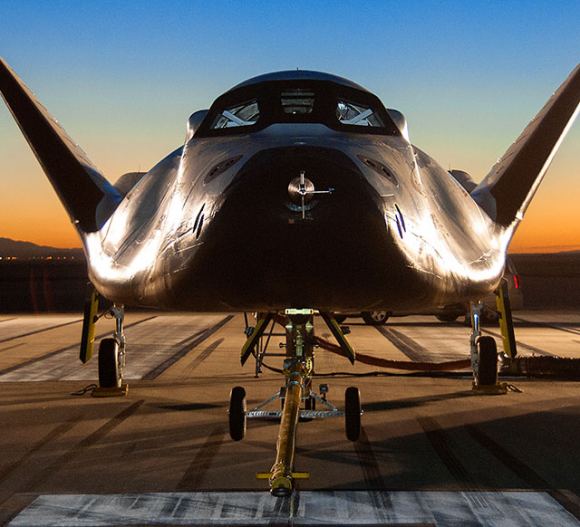
NASA’s Next-Generation Spaceplane Passes Free Flight Test It’s called the Dream Chaser, a reusable spaceplane that will one day transport cargo and crews to the International Space Station. For the past ten years, the Sierra Nevada Corporation and NASA have been developing and testing this next-generation space vehicle. When it is ready, this vehicle will not only provide a more cost-effective way of servicing the ISS, it will also help restore domestic launch capability to the United States. On Saturday, November 11th, the Dream Chaser passed an important milestone by conducting a successful free flight test. This took place at Edwards Air Force Base inRead More →

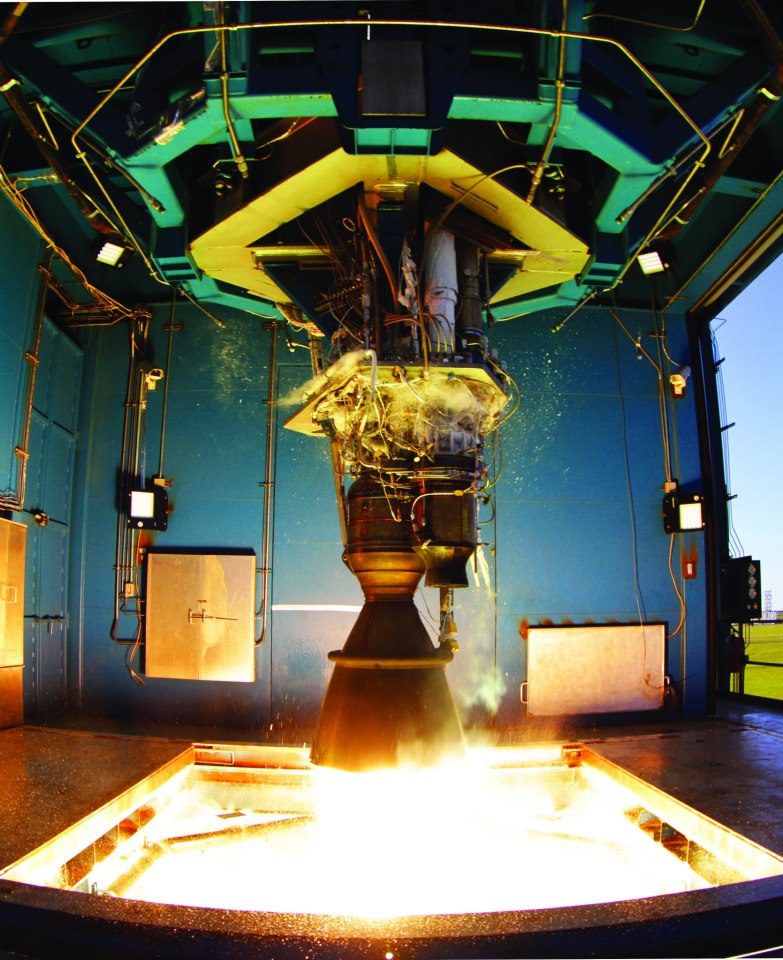
Despite Merlin Engine Testing Anomaly SpaceX Forges Ahead With Ambitious Year End Launch Schedule Commencing Nov. 15 A Falcon 9 Merlin 1D engine during hot fire engine test firing on a test stand in McGregor, Texas in this February 2012 file photo. Credit: SpaceX KENNEDY SPACE CENTER, FL – Despite suffering a significant engine testing “anomaly” and fire during test protocols with a Merlin engine test that powers both stages of SpaceX’s Falcon 9 rocket, the Elon Musk founded company is forging ahead with an ambitious year end launch schedule that commences this week with blastoff of the secretive Zuma mission on Wednesday evening, Nov.Read More →

The first astronomers had a limited toolkit: their eyes. They could only observe those stars, planets and celestial events bright enough to pick up unassisted. But today’s astronomers use increasingly sensitive and sophisticated instruments to view and track a bevy of cosmic wonders, including objects and events that were too dim or distant for their sky-gazing forebears. Powered by WPeMaticoRead More →
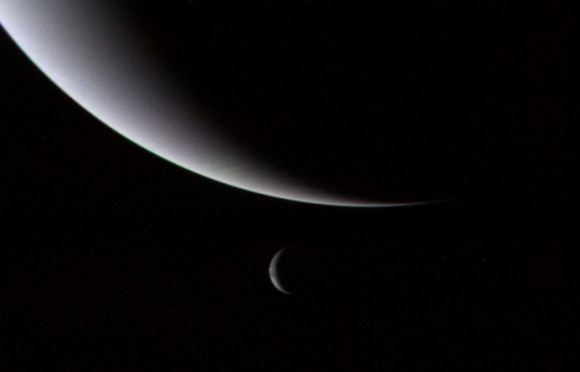
Triton’s Arrival was Chaos for the Rest of Neptune’s Moons The study of the Solar System’s many moons has revealed a wealth of information over the past few decades. These include the moons of Jupiter – 69 of which have been identified and named – Saturn (which has 62) and Uranus (27). In all three cases, the satellites that orbit these gas giants have prograde, low-inclination orbits. However, within the Neptunian system, astronomers noted that the situation was quite different. Compared to the other gas giants, Neptune has far fewer satellites, and most of the system’s mass is concentrated within a single satellite that isRead More →

A new robotic camera with the ability to capture hundreds of thousands of stars and galaxies in a single shot has taken its first image of the sky—an event astronomers refer to as “first light.” The camera is the centerpiece of a new automated sky survey project called the Zwicky Transient Facility (ZTF), based at Caltech’s Palomar Observatory near San Diego, California. Powered by WPeMaticoRead More →
Astrophysicists from MSU (Russia) and colleagues from Italy and Russian Academy of Sciences have found the first observational evidence for a contracting white dwarf. Constant high spin-up rate of a star of this type, located in an enigmatic binary system, can be easily explained if the white dwarf is contracting, the researchers argue. The discovery is reported in the Monthly Notices of the Royal Astronomical Society. Powered by WPeMaticoRead More →

(Phys.org)—A group of astronomers has discovered a giant nebula of ionized gas extending over 300,000 light years. This nebula turns out to be associated with the quasar dubbed the “Teacup.” The finding was presented November 7 in a paper published online on the arXiv pre-print server. Powered by WPeMaticoRead More →

Rotating black holes and computers that use quantum-mechanical phenomena to process information are topics that have fascinated science lovers for decades, but even the most innovative thinkers rarely put them together. Now, however, theoretical physicist Ovidiu Racorean from the General Direction of Information Technology, Bucharest, Romania suggests that powerful X-rays emitted near these black holes have properties that make them ideal information carriers for quantum computing. This work was recently published in New Astronomy. Powered by WPeMaticoRead More →

We have a fair understanding of the fundamental mechanisms that regulate star formation in galaxies, from the interstellar matter to the diffuse clouds distributed in space whose gravitational contraction leads to the birth of stars within large stellar clusters. But observations of distant galaxies have questioned this picture, the size and mass of these distant stellar nurseries largely exceeding that of their local counterparts. An international team of astrophysicists led by the Universities of Geneva (UNIGE), Switzerland, for the observations and Zurich (UZH) for the simulations has tackled this inconsistency, which seems to question our knowledge of star formation when we study the early universe,Read More →

Dinosaur Killing Asteroid hit Earth in Exactly the Wrong Spot Sixty-six million years ago, an asteroid struck Earth in what is now the Yucatan Peninsula in southern Mexico. This event, known as the Chicxulub asteroid impact, measured 9 km in diameter and caused extreme global cooling and drought. This led to a mass extinction, which not only claimed the lives of the dinosaurs, but also wiped out about 75% of all land and sea animals on Earth. However, had this asteroid impacted somewhere else on the planet, things could have turned out very differently. According to a new study produced by a team of JapaneseRead More →