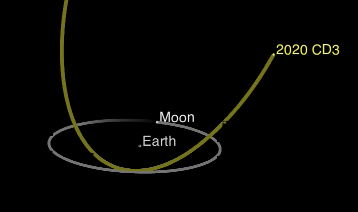
Tiny Object Discovered in Distant Orbit Around the Earth A small object, presumed to be a tiny asteroid, has been discovered in a distant orbit about the Earth, a highly unusual circumstance, since asteroids normally orbit the Sun. The new “mini-moon” has been given the asteroid designation 2020 CD3, but in view of its strange orbit, there is a chance that the object is an old lunar spacecraft or a small discarded rocket stage. Based on its brightness, 2020 CD3 is very small, no more than 1 to 2 meters (3 to 6 feet) in size. The discovery was made on February 15, 2020 byRead More →

A Picture of Earth’s New Temporary Moon With the excitement and interest in the newly discovered ‘mini-moon’ found orbiting Earth, astronomers quickly set their sights on trying to get more details, to determine what this object actually is. Using the Gemini Observatory in Hawaii, a group of astronomers captured a clearer view of this so-called Temporarily Captured Object (TCO), named 2020 CD3. … Continue reading “A Picture of Earth’s New Temporary Moon” The post A Picture of Earth’s New Temporary Moon appeared first on Universe Today. Universe Today Go to SourceRead More →

Physicists model the supernovae that result from pulsating supergiants like Betelgeuse Betelgeuse has been the center of significant media attention lately. The red supergiant is nearing the end of its life, and when a star over 10 times the mass of the Sun dies, it goes out in spectacular fashion. With its brightness recently dipping to the lowest point in the last hundred years, many space enthusiasts are excited that Betelgeuse may soon go supernova, exploding in a dazzling display that could be visible even in daylight. phys.org Go to SourceRead More →

Riding the Wave of a Supernova to Go Interstellar A new paper by two Harvard professors explores the idea of using supernova as a means of high-speed interstellar travel – something advanced alien species could be doing right now! The post Riding the Wave of a Supernova to Go Interstellar appeared first on Universe Today. Universe Today Go to SourceRead More →

Examining ice giants with NASA’s Webb telescope Far-flung Uranus and Neptune—the ice giants of our solar system—are as mysterious as they are distant. Soon after its launch in 2021, NASA’s James Webb Space Telescope will change that by unlocking secrets of the atmospheres of both planets. phys.org Go to SourceRead More →

Plasma jet deceleration could be caused by the interaction with the stars Manel Perucho, professor of the Department of Astronomy and Astrophysics at the University of Valencia has proposed an explanation for the origin of the deceleration of plasma jets (loss of speed along the matter and energy channels emanating from the central regions of an active galaxy), a subject that has been debated in recent decades. phys.org Go to SourceRead More →

The Leoncino Dwarf Galaxy: Exploring the Low-Metallicity End of the Luminosity-Metallicity and Mass-Metallcity Relations. (arXiv:2002.11723v1 [astro-ph.GA]) <a href="http://arxiv.org/find/astro-ph/1/au:+McQuinn_K/0/1/0/all/0/1">Kristen. B. W. McQuinn</a>, <a href="http://arxiv.org/find/astro-ph/1/au:+Berg_D/0/1/0/all/0/1">Danielle A. Berg</a>, <a href="http://arxiv.org/find/astro-ph/1/au:+Skillman_E/0/1/0/all/0/1">Evan D. Skillman</a>, <a href="http://arxiv.org/find/astro-ph/1/au:+Adams_E/0/1/0/all/0/1">Elizabeth Adams</a>, <a href="http://arxiv.org/find/astro-ph/1/au:+Cannon_J/0/1/0/all/0/1">John M. Cannon</a>, <a href="http://arxiv.org/find/astro-ph/1/au:+Dolphin_A/0/1/0/all/0/1">Andrew E. Dolphin</a>, <a href="http://arxiv.org/find/astro-ph/1/au:+Salzer_J/0/1/0/all/0/1">John J. Salzer</a>, <a href="http://arxiv.org/find/astro-ph/1/au:+Giovanelli_R/0/1/0/all/0/1">Riccardo Giovanelli</a>, <a href="http://arxiv.org/find/astro-ph/1/au:+Haynes_M/0/1/0/all/0/1">Martha P. Haynes</a>, <a href="http://arxiv.org/find/astro-ph/1/au:+Hirschauer_A/0/1/0/all/0/1">Alec S. Hirschauer</a>, <a href="http://arxiv.org/find/astro-ph/1/au:+Janoweicki_S/0/1/0/all/0/1">Steven Janoweicki</a>, <a href="http://arxiv.org/find/astro-ph/1/au:+Klapkowski_M/0/1/0/all/0/1">Myles Klapkowski</a>, <a href="http://arxiv.org/find/astro-ph/1/au:+Rhode_K/0/1/0/all/0/1">Katherine L. Rhode</a> Extremely metal-poor (XMP) galaxies are low-mass, star-forming galaxies with gas-phase oxygen abundances below 12+log(O/H) = 7.35 (~1/20 Zsun). Galaxy evolution scenarios suggest three pathways to form an XMP: (1) secular evolution at low galaxy masses, (2) slow evolution in voids,Read More →

Frequency of Planets in Binaries. (arXiv:2002.11734v1 [astro-ph.EP]) <a href="http://arxiv.org/find/astro-ph/1/au:+Bonavita_M/0/1/0/all/0/1">Mariangela Bonavita</a>, <a href="http://arxiv.org/find/astro-ph/1/au:+Desidera_S/0/1/0/all/0/1">Silvano Desidera</a> The frequency of planets in binaries is an important issue in the field of extrasolar planet studies because of its relevance in the estimation of the global planet population of our galaxy and the clues it can give to our understanding of planet formation and evolution. Multiple stars have often been excluded from exoplanet searches, especially those performed using the radial velocity technique, due to the technical challenges posed by such targets. As a consequence and despite recent efforts, our knowledge of the frequency of planets in multiple stellar systems is stillRead More →

Velocity-coherent Filaments in NGC 1333: Evidence for Accretion Flow?. (arXiv:2002.11736v1 [astro-ph.GA]) <a href="http://arxiv.org/find/astro-ph/1/au:+Chen_M/0/1/0/all/0/1">Michael Chun-Yuan Chen</a>, <a href="http://arxiv.org/find/astro-ph/1/au:+Francesco_J/0/1/0/all/0/1">James Di Francesco</a>, <a href="http://arxiv.org/find/astro-ph/1/au:+Rosolowsky_E/0/1/0/all/0/1">Erik Rosolowsky</a>, <a href="http://arxiv.org/find/astro-ph/1/au:+Keown_J/0/1/0/all/0/1">Jared Keown</a>, <a href="http://arxiv.org/find/astro-ph/1/au:+Pineda_J/0/1/0/all/0/1">Jaime E. Pineda</a>, <a href="http://arxiv.org/find/astro-ph/1/au:+Friesen_R/0/1/0/all/0/1">Rachel K. Friesen</a>, <a href="http://arxiv.org/find/astro-ph/1/au:+Caselli_P/0/1/0/all/0/1">Paola Caselli</a>, <a href="http://arxiv.org/find/astro-ph/1/au:+Chen_H/0/1/0/all/0/1">How-Huan Chen</a>, <a href="http://arxiv.org/find/astro-ph/1/au:+Matzner_C/0/1/0/all/0/1">Christopher D. Matzner</a>, <a href="http://arxiv.org/find/astro-ph/1/au:+Offner_S/0/1/0/all/0/1">Stella S. Offner</a>, <a href="http://arxiv.org/find/astro-ph/1/au:+Punanova_A/0/1/0/all/0/1">Anna Punanova</a>, <a href="http://arxiv.org/find/astro-ph/1/au:+Redaelli_E/0/1/0/all/0/1">Elena Redaelli</a>, <a href="http://arxiv.org/find/astro-ph/1/au:+Scibelli_S/0/1/0/all/0/1">Samantha Scibelli</a>, <a href="http://arxiv.org/find/astro-ph/1/au:+Shirley_Y/0/1/0/all/0/1">Yancy Shirley</a> Recent observations of global velocity gradients across and along molecular filaments have been interpreted as signs of gas accreting onto and along these filaments, potentially feeding star-forming cores and proto-clusters. The behavior of velocity gradients in filaments, however, has not been studied in detail, particularly onRead More →

Prospects for gamma-ray observations of narrow-line Seyfert 1 galaxies with the Cherenkov Telescope Array II. Gamma-gamma absorption in the broad-line region radiation fields. (arXiv:2002.11737v1 [astro-ph.HE]) <a href="http://arxiv.org/find/astro-ph/1/au:+Romano_P/0/1/0/all/0/1">P. Romano</a> (1,2), <a href="http://arxiv.org/find/astro-ph/1/au:+Bottcher_M/0/1/0/all/0/1">M. B&#xf6;ttcher</a> (3), <a href="http://arxiv.org/find/astro-ph/1/au:+Foschini_L/0/1/0/all/0/1">L. Foschini</a> (1), <a href="http://arxiv.org/find/astro-ph/1/au:+Boisson_C/0/1/0/all/0/1">C. Boisson</a> (2), <a href="http://arxiv.org/find/astro-ph/1/au:+Vercellone_S/0/1/0/all/0/1">S. Vercellone</a>, <a href="http://arxiv.org/find/astro-ph/1/au:+Landoni_M/0/1/0/all/0/1">M. Landoni</a> (1), ((1) INAF/OAB, (2) LUTH/OdP/CNRS/U Paris, (3) CFR North-Western U.) Gamma-ray emitting narrow-line Seyfert 1 ($gamma$-NLS1) galaxies possibly harbour relatively low-mass black holes (10$^6$-10$^8$ M$_{odot}$) accreting close to the Eddington limit, and share many characteristics with their sibling sources, flat-spectrum radio quasars. Although they have been detected in the MeV–GeV band with Fermi-LAT, they have never been seenRead More →

Higgs Inflation as Nonlinear Sigma Model and Scalaron as its $sigma$-meson. (arXiv:2002.11739v1 [hep-ph]) <a href="http://arxiv.org/find/hep-ph/1/au:+Ema_Y/0/1/0/all/0/1">Yohei Ema</a>, <a href="http://arxiv.org/find/hep-ph/1/au:+Mukaida_K/0/1/0/all/0/1">Kyohei Mukaida</a>, <a href="http://arxiv.org/find/hep-ph/1/au:+Vis_J/0/1/0/all/0/1">Jorinde van de Vis</a> We point out that a model with scalar fields with a large nonminimal coupling to the Ricci scalar, such as Higgs inflation, can be regarded as a nonlinear sigma model (NLSM). The $sigma$-meson, which is induced by quantum corrections, is identified as the scalaron in this model. Our understanding provides a novel alternative picture for the emergence of the scalaron, which was previously studied in the Jordan frame by computing the running of the term quadratic in the Ricci scalar. WeRead More →

X-ray scaling relations for a representative sample of Planck selected clusters observed with XMM-Newton. (arXiv:2002.11740v1 [astro-ph.CO]) <a href="http://arxiv.org/find/astro-ph/1/au:+Lovisari_L/0/1/0/all/0/1">Lorenzo Lovisari</a>, <a href="http://arxiv.org/find/astro-ph/1/au:+Schellenberger_G/0/1/0/all/0/1">Gerrit Schellenberger</a>, <a href="http://arxiv.org/find/astro-ph/1/au:+Sereno_M/0/1/0/all/0/1">Mauro Sereno</a>, <a href="http://arxiv.org/find/astro-ph/1/au:+Ettori_S/0/1/0/all/0/1">Stefano Ettori</a>, <a href="http://arxiv.org/find/astro-ph/1/au:+Pratt_G/0/1/0/all/0/1">Gabriel W. Pratt</a>, <a href="http://arxiv.org/find/astro-ph/1/au:+Forman_W/0/1/0/all/0/1">William R. Forman</a>, <a href="http://arxiv.org/find/astro-ph/1/au:+Jones_C/0/1/0/all/0/1">Christine Jones</a>, <a href="http://arxiv.org/find/astro-ph/1/au:+Andrade_Santos_F/0/1/0/all/0/1">Felipe Andrade-Santos</a>, <a href="http://arxiv.org/find/astro-ph/1/au:+Randall_S/0/1/0/all/0/1">Scott Randall</a>, <a href="http://arxiv.org/find/astro-ph/1/au:+Kraft_R/0/1/0/all/0/1">Ralph Kraft</a> We report the scaling relations derived by fitting the X-ray parameters determined from analyzing the XMM-Newton observations of 120 galaxy clusters in the Planck Early Sunyaev-Zel’dovich sample spanning the redshift range of 0.059$<$$z$$<$0.546. We find that the slopes of all the investigated scaling relations significantly deviate from the self-similar predictions, if self-similar redshift evolution is assumed. WhenRead More →

How much do underestimated field strengths from Zeeman-Doppler imaging affect spin-down torque estimates?. (arXiv:2002.11774v1 [astro-ph.SR]) <a href="http://arxiv.org/find/astro-ph/1/au:+See_V/0/1/0/all/0/1">Victor See</a>, <a href="http://arxiv.org/find/astro-ph/1/au:+Lehmann_L/0/1/0/all/0/1">Lisa Lehmann</a>, <a href="http://arxiv.org/find/astro-ph/1/au:+Matt_S/0/1/0/all/0/1">Sean P. Matt</a>, <a href="http://arxiv.org/find/astro-ph/1/au:+Finley_A/0/1/0/all/0/1">Adam J. Finley</a> Numerous attempts to estimate the rate at which low-mass stars lose angular momentum over their lifetimes exist in the literature. One approach is to use magnetic maps derived from Zeeman-Doppler imaging (ZDI) in conjunction with so-called “braking laws”. The use of ZDI maps has advantages over other methods because it allows information about the magnetic field geometry to be incorporated into the estimate. However, ZDI is known to underestimate photospheric field strengths due to flux cancellationRead More →

The Spin Dependence of the Fundamental Plane of Black Hole Activity. (arXiv:2002.11778v1 [astro-ph.HE]) <a href="http://arxiv.org/find/astro-ph/1/au:+Unal_C/0/1/0/all/0/1">Caner Unal</a>, <a href="http://arxiv.org/find/astro-ph/1/au:+Loeb_A/0/1/0/all/0/1">Abraham Loeb</a> The Fundamental Plane (FP) of Black Hole (BH) Activity in galactic nuclei relates X-ray and radio luminosities to BH mass and accretion rate. However, there is a large scatter exhibited by the data, which motivated us for a new variable. We add BH spin as a new variable and estimate the spin dependence of the jet power and disk luminosity in terms of radio and X-ray luminosities. We assume the Blandford-Znajek process as the main source of the outflow, and find that the jet power dependsRead More →

Towards a complete description of spectra and polarization of black hole accretion disks: albedo profiles and returning radiation. (arXiv:2002.11788v1 [astro-ph.HE]) <a href="http://arxiv.org/find/astro-ph/1/au:+Taverna_R/0/1/0/all/0/1">Roberto Taverna</a>, <a href="http://arxiv.org/find/astro-ph/1/au:+Zhang_W/0/1/0/all/0/1">Wenda Zhang</a>, <a href="http://arxiv.org/find/astro-ph/1/au:+Dovciak_M/0/1/0/all/0/1">Michal Dov&#x10d;iak</a>, <a href="http://arxiv.org/find/astro-ph/1/au:+Bianchi_S/0/1/0/all/0/1">Stefano Bianchi</a>, <a href="http://arxiv.org/find/astro-ph/1/au:+Bursa_M/0/1/0/all/0/1">Michal Bursa</a>, <a href="http://arxiv.org/find/astro-ph/1/au:+Karas_V/0/1/0/all/0/1">Vladimir Karas</a>, <a href="http://arxiv.org/find/astro-ph/1/au:+Matt_G/0/1/0/all/0/1">Giorgio Matt</a> Accretion disks around stellar-mass black holes (BHs) emit radiation peaking in the soft X-rays when the source is in the thermal state. The emerging photons are polarized and, for symmetry reasons, the polarization integrated over the source is expected to be either parallel or perpendicular to the (projected) disk symmetry axis, because of electron scattering in the disk. However, due to General Relativity effectsRead More →

A systematic study of radiative torque grain alignment in the diffuse interstellar medium. (arXiv:2002.11792v1 [astro-ph.IM]) <a href="http://arxiv.org/find/astro-ph/1/au:+Reissl_S/0/1/0/all/0/1">Stefan Reissl</a>, <a href="http://arxiv.org/find/astro-ph/1/au:+Guillet_V/0/1/0/all/0/1">Vincent Guillet</a>, <a href="http://arxiv.org/find/astro-ph/1/au:+Brauer_R/0/1/0/all/0/1">Robert Brauer</a>, <a href="http://arxiv.org/find/astro-ph/1/au:+Levrier_F/0/1/0/all/0/1">Fran&#xe7;ois Levrier</a>, <a href="http://arxiv.org/find/astro-ph/1/au:+Boulanger_F/0/1/0/all/0/1">Fran&#xe7;ois Boulanger</a>, <a href="http://arxiv.org/find/astro-ph/1/au:+Klessen_R/0/1/0/all/0/1">Ralf S. Klessen</a> Context. Planck observations demonstrated that the grain alignment efficiency is almost constant in the diffuse ISM. Aims. We test if the Radiative Torque (RAT) theory is compatible with observational constraints on grain alignment. Methods. We combine a numerical simulation with the radiative transfer code POLARIS that incorporates a physical dust model and the detailed grain alignment physics of RATs. A dust model is designed to reproduce the spectral dependence of extinctionRead More →

The Trigger Mechanism of Recurrent Solar Active Region Jets Revealed by the Magnetic Properties of a Coronal Geyser Site. (arXiv:2002.11819v1 [astro-ph.SR]) <a href="http://arxiv.org/find/astro-ph/1/au:+Paraschiv_A/0/1/0/all/0/1">Alin Razvan Paraschiv</a>, <a href="http://arxiv.org/find/astro-ph/1/au:+Donea_A/0/1/0/all/0/1">Alina Donea</a>, <a href="http://arxiv.org/find/astro-ph/1/au:+Leka_K/0/1/0/all/0/1">K.D. Leka</a> Solar active region jets are small-scale collimated plasma eruptions that are triggered from magnetic sites embedded in sunspot penumbral regions. Multiple trigger mechanisms for recurrent jets are under debate. Vector magnetic field data from SDO-HMI observations are used to analyze a prolific photospheric configuration, identified in extreme ultraviolet observations as a `Coronal Geyser’, that triggered a set of at least 10 recurrent solar active region jets. We focus on interpreting the magnetic fields ofRead More →

Light curves from highly compact neutron stars with spot size effect. (arXiv:2002.11840v1 [astro-ph.HE]) <a href="http://arxiv.org/find/astro-ph/1/au:+Sotani_H/0/1/0/all/0/1">Hajime Sotani</a> We systematically examine light curves from a single hot spot on a slowly rotating neutron star with very high compactness, where the so-called invisible zone does not exist. In particular, we adopt three different shapes of hot spot and take into account the finite size effect of hot spot on the light curves. Then, we find that the brightening of flux occurs when the hot spot with small area crosses the opposite side to the observer, where the brightening becomes stronger as the area of hot spot decreases. SinceRead More →