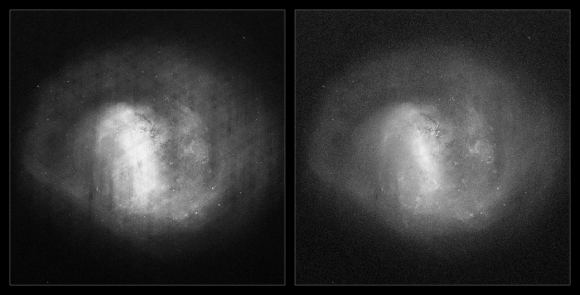
Gaia Looks Beyond our Galaxy to Other Islands of Stars The European Space Agency’s (ESA) Gaia mission is an ambitious project. Having launched in December of 2013, the purpose of this space observatory has been to measure the position and distances of 1 billion objects – including stars, extra-solar planets, comets, asteroids and even quasars. From this, astronomers hope to create the most detailed 3D space catalog of the cosmos ever made. Back in 2016, the first batch of Gaia data (based on its first 14 months in space) was released. Since then, scientists have been pouring over the raw data to obtain clearer imagesRead More →
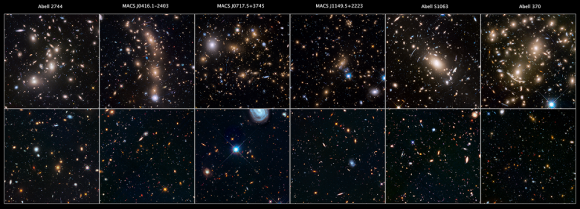
Are Little Blue Dots in the Hubble Frontier Fields Precursors to Globular Clusters? In 2012, the Hubble Space Telescope Frontier Fields program (aka. Hubble Deep Fields Initiative 2012) officially kicked off. The purpose of this project was to study the faintest and most distant galaxies in the Universe using the gravitational lensing technique, thus advancing our knowledge of early galaxy formation. By 2017, the Frontier Field program wrapped up, and the hard work of analyzing all the data it collected began. One of the more interesting finds within the Frontier Fields data has been the discovery of low mass galaxies with high star formation rates.Read More →

The design for the Keck Cosmic Web Imager (KCWI) includes two separate channels to detect light in the blue (350 to 560 nm) and the red (530 nm to 1050 nm) portions of the visible wavelength spectrum. KCWI-Blue was commissioned and started routine science observations in September 2017 and is obtaining superb and exciting new results while operating flawlessly. Powered by WPeMaticoRead More →

A riot of colour and light dances through this peculiarly shaped galaxy, NGC 5256. Its smoke-like plumes are flung out in all directions and the bright core illuminates the chaotic regions of gas and dust swirling through the galaxy’s centre. Its odd structure is due to the fact that this is not one galaxy, but two—in the process of a galactic collision. Powered by WPeMaticoRead More →

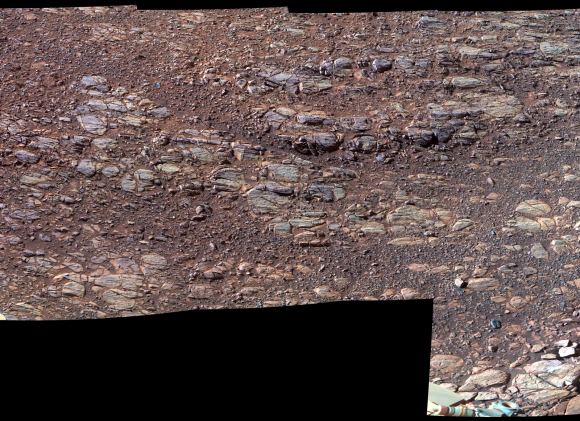
NASA’s Opportunity Rover Withstands Another Harsh Winter on Mars When the Opportunity rover landed on Mars on January 25th, 2004, its mission was only meant to last for about 90 Earth days. But the little rover that could has exceeded all expectations by remaining in operation (as of the writing of this article) for a total of 13 years and 231 days and traveled a total of about 50 km (28 mi). Basically, Opportunity has continued to remain mobile and gather scientific data 50 times longer than its designated lifespan. And according to a recent announcement from NASA’s Mars Exploration Program (MEP), the rover managedRead More →

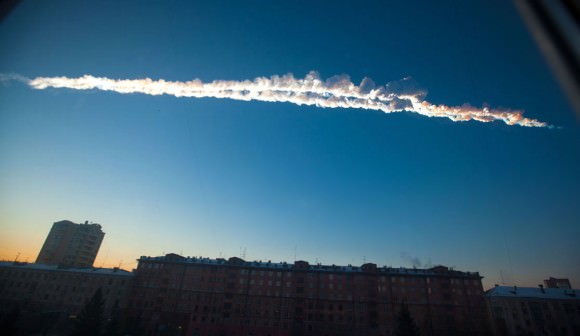
Meteors Explode from the Inside When They Reach the Atmosphere Earth is no stranger to meteors. In fact, meteor showers are a regular occurrence, where small objects (meteoroids) enter the Earth’s atmosphere and radiate in the night sky. Since most of these objects are smaller than a grain of sand, they never reach the surface and simply burn up in the atmosphere. But very so often, a meteor of sufficient size will make it through and explode above the surface, where it can cause considerable damage. A good example of this is the Chelyabinsk meteoroid, which exploded in the skies over Russia in February ofRead More →

There was much excitement when scientists witnessed the violent collision of two ultra-dense, massive stars more than 100m light years from the Earth earlier this year. Not only did they catch the resulting gravitational waves – ripples in the fabric of spacetime – they also saw a practically instantaneous flash of light. This is exciting in itself and was the first direct evidence for a merger of neutron stars. Powered by WPeMaticoRead More →

Stellar Nursery Blooms into View The OmegaCAM camera on ESO’s VLT Survey Telescope has captured this glittering view of the stellar nursery called Sharpless 29. Many astronomical phenomena can be seen in this giant image, including cosmic dust and gas clouds that reflect, absorb, and re-emit the light of hot young stars within the nebula. ESO News Feed Go to Source Powered by WPeMaticoRead More →

ESOcast 142 Light: Stellar Nursery Blooms into View (4K UHD) The OmegaCAM imager on ESO’s VLT Survey Telescope at the Paranal Observatory in Chile has captured a glittering view of the stellar nursery called Sharpless 29. Many astronomical phenomena can be seen in the giant image, including cosmic dust and gas clouds that reflect, absorb, and re-emit the light of hot young stars within the nebula. Powered by WPeMaticoRead More →